Boost Your Grades: Effective Academic Performance Strategies Revealed
Boost Your Grades: Effective Academic Performance Strategies Revealed
Achieving academic success is a journey that requires more than just attending lectures and completing assignments. It’s about adopting a strategic approach to learning, one that maximizes retention, understanding, and application of knowledge. This guide delves into effective academic performance strategies designed to help you not only improve your grades but also cultivate a deeper, more meaningful learning experience. By implementing these techniques, you can transform your study habits and unlock your full academic potential.
Key Points:
- Strategic Study Planning: Organize your time effectively for maximum learning impact.
- Active Learning Techniques: Engage with material to enhance comprehension and retention.
- Effective Note-Taking: Capture and process information efficiently.
- Regular Review and Practice: Reinforce learning through consistent engagement.
- Well-being Integration: Prioritize health for optimal cognitive function.
Mastering Your Learning: Foundational Strategies for Academic Excellence
The pursuit of higher grades is a common goal for students at all levels. However, many struggle to identify the most effective methods to achieve this. Traditional study habits, such as passive rereading, often prove insufficient. Instead, focusing on active engagement with the material is paramount. This involves understanding how your brain learns best and applying scientifically-backed techniques to enhance your academic performance. From optimizing your study schedule to leveraging cutting-edge learning methodologies, this comprehensive guide will equip you with the tools needed to excel.
The Power of Active Learning: Moving Beyond Passive Consumption
Passive learning, like rereading notes or textbooks, lulls the brain into a false sense of familiarity. Active learning, conversely, requires you to actively retrieve, process, and manipulate information. This deepens understanding and makes knowledge more accessible during assessments. This section will explore several proven academic performance boosters that fall under this active umbrella.
Effective Study Planning and Time Management
A well-structured study plan is the bedrock of academic success. Without it, studying can become haphazard and inefficient, leading to procrastination and missed opportunities for deep learning.
- Create a Master Schedule: Outline all your courses, assignments, exams, and extracurricular activities for the semester.
- Break Down Tasks: Divide large assignments or study topics into smaller, manageable chunks. This makes them less daunting and easier to tackle.
- Prioritize Ruthlessly: Use techniques like the Eisenhower Matrix (Urgent/Important) to focus your energy on high-impact activities.
- Allocate Study Blocks: Dedicate specific time slots for studying each subject, ensuring consistency. Pomodoro Technique (study for 25 minutes, break for 5) can be highly effective.
- Schedule Review Time: Integrate regular review sessions into your schedule, not just cramming before exams.
Strategic Note-Taking for Enhanced Retention
Effective note-taking isn't just about transcribing information; it's about processing and synthesizing it. The way you take notes can significantly impact your ability to recall and understand the material later.
- Cornell Note-Taking System: Divide your note page into three sections: main notes, cues/questions, and a summary. This encourages active recall during review.
- Mind Mapping: Visually represent information and its connections. This is excellent for understanding complex relationships between concepts.
- Sketchnoting: Combine drawings, symbols, and text to create visual notes. This can make learning more engaging and memorable.
- Digital vs. Pen and Paper: While digital tools offer convenience, studies suggest that writing by hand can lead to better retention for some learners. Consider which method best suits your learning style and the material.
Advanced Academic Performance Strategies Revealed
Beyond foundational planning and note-taking, several advanced techniques can significantly elevate your academic performance. These methods focus on actively challenging your understanding and reinforcing memory pathways.
The Unrivaled Power of Active Recall
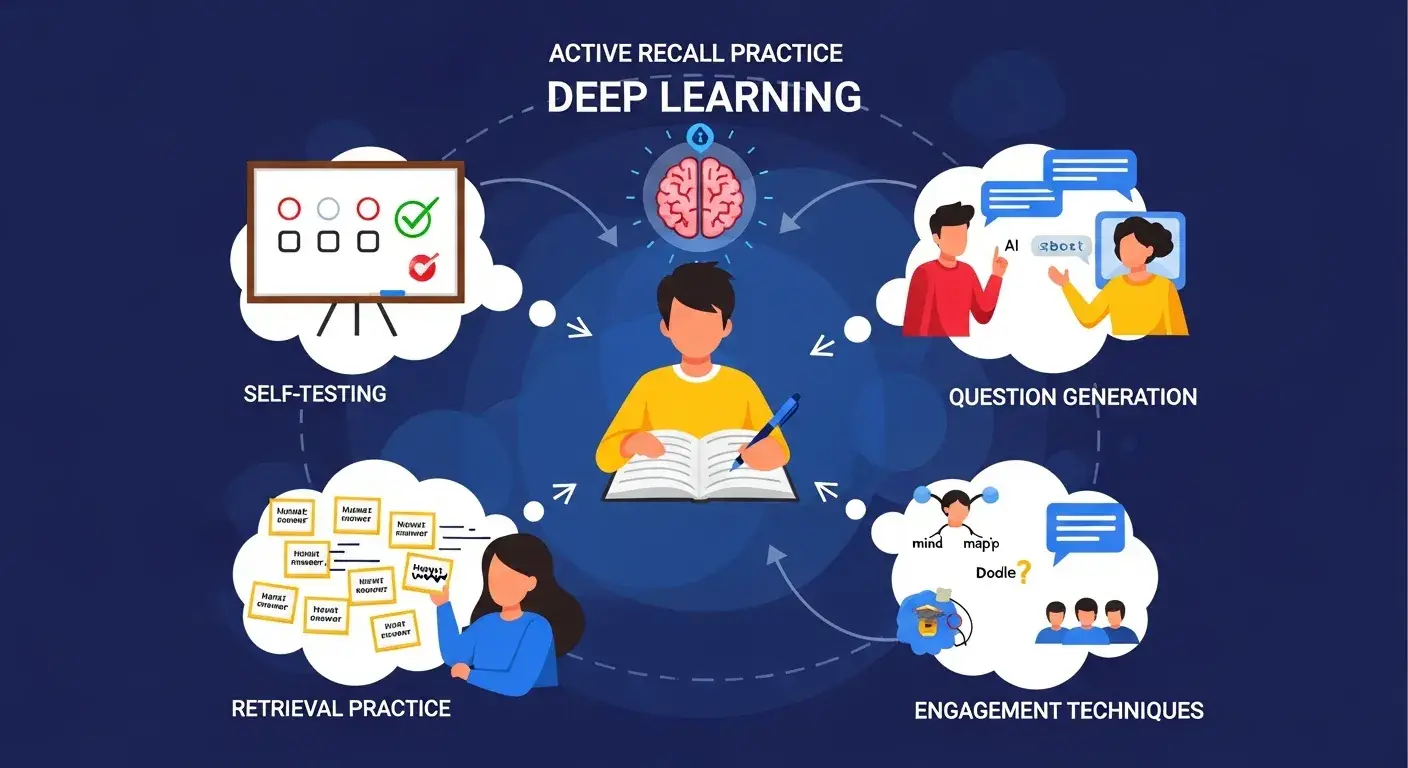
Active recall, also known as the retrieval practice effect, is arguably one of the most powerful learning strategies. It involves forcing your brain to retrieve information from memory, rather than passively reviewing it. This process strengthens neural connections, making the information more accessible for future recall.
- Flashcards: Create flashcards for definitions, formulas, dates, or key concepts. Regularly test yourself by trying to recall the answer before flipping the card.
- Practice Questions: Work through practice problems, quizzes, and past exam papers. Focus on understanding why you got an answer right or wrong.
- Self-Quizzing: After reading a section, close your book or notes and try to explain the key concepts aloud or write them down from memory.
- Teach Someone Else: Explaining a concept to a friend or even a rubber duck (the "rubber duck debugging" method adapted for learning) forces you to organize your thoughts and identify gaps in your understanding.
According to research published in the Journal of Educational Psychology (2024), students who regularly engaged in active recall demonstrated significantly higher retention rates and improved performance on cumulative exams compared to those who relied solely on rereading.
Spaced Repetition: Fighting the Forgetting Curve
The forgetting curve illustrates that we naturally forget information over time. Spaced repetition is a learning technique that combats this by scheduling review sessions at increasing intervals. This ensures that you revisit material just as you are about to forget it, reinforcing memory and leading to long-term retention.
- Software Tools: Apps like Anki or Quizlet utilize algorithms to present flashcards or questions at optimal intervals.
- Manual Scheduling: You can manually implement spaced repetition by reviewing notes after a day, then three days, then a week, and so on.
Interleaving: Mixing Up Your Subjects
Interleaving involves mixing different subjects or topics within a single study session, rather than studying one topic exhaustively before moving to the next (blocking). While it might feel more difficult initially, interleaving improves your ability to distinguish between different concepts and apply the correct strategies or knowledge in a test setting.
- Example: Instead of studying all of Chapter 1 math, then all of Chapter 2 math, you might work through problems from both chapters in one session.
- Interdisciplinary Study: Even mixing different subjects, like history and biology, can promote deeper understanding of underlying principles and enhance problem-solving skills.
Elaboration and Explanation: Deepening Your Understanding
Elaboration involves expanding on new information by connecting it to existing knowledge, explaining it in your own words, or thinking of examples. This process encourages deeper cognitive processing.
- Ask "Why?" and "How?": Constantly question the material. Why is this important? How does this concept relate to others?
- Create Analogies: Compare new concepts to things you already understand.
- Real-World Applications: Think about where this knowledge is applied in the real world.
A 2023 study in Contemporary Educational Psychology highlighted that students who actively elaborated on learning material, by generating their own examples and explanations, showed superior long-term memory and problem-solving capabilities.
Differentiated Value: Beyond Traditional Study Advice
Many sources offer generic study tips. Here, we introduce two crucial, often overlooked, aspects of boosting academic performance: metacognition and the integration of well-being.
1. Cultivating Metacognition: Thinking About Your Thinking
Metacognition is the ability to understand and regulate your own learning processes. It's about being aware of what you know, what you don't know, and how you learn best. This self-awareness is a powerful tool for optimizing study strategies.
- Self-Assessment: Regularly ask yourself: "What did I learn today?" "What am I still struggling with?" "Which study method worked best for this topic?"
- Strategy Adjustment: Based on your self-assessment, adjust your study methods. If flashcards aren't working for a particular subject, try mind mapping.
- Goal Setting: Set specific, measurable, achievable, relevant, and time-bound (SMART) goals for your study sessions.
Developing metacognitive skills allows you to become a more independent and effective learner, capable of identifying and overcoming your own learning challenges. This proactive approach is a hallmark of consistently high-performing students.
2. Prioritizing Well-being for Peak Cognitive Function
It's impossible to perform optimally academically if your physical and mental health are compromised. Integrating well-being into your academic strategy is not a luxury; it's a necessity.
- Adequate Sleep: Aim for 7-9 hours of quality sleep per night. Sleep is crucial for memory consolidation and cognitive function. (Source: National Sleep Foundation, 2023 recommendations)
- Healthy Nutrition: Fuel your brain with balanced meals. Avoid excessive sugar and processed foods that can lead to energy crashes.
- Regular Exercise: Physical activity improves blood flow to the brain, enhances mood, and reduces stress. Even short bursts of exercise can be beneficial.
- Stress Management: Incorporate mindfulness, meditation, hobbies, or spending time in nature to manage academic stress effectively.
- Social Connection: Maintain healthy relationships. Social support can significantly buffer stress and improve overall well-being.
Neglecting these fundamentals can severely hinder your ability to learn, retain information, and perform well under pressure. Prioritizing your health is a direct investment in your academic success.
Frequently Asked Questions (FAQ)
Q1: How can I overcome procrastination when I have a lot of material to study? A1: Break down large tasks into smaller, more manageable steps. Use techniques like the Pomodoro Technique to start with short, focused study sessions. Reward yourself for completing milestones. Identify the root cause of your procrastination—often it's fear or overwhelm—and address it directly.
Q2: Is it better to study one subject for a long time or switch between subjects? A2: While focused study on one subject (blocking) can be effective for initial learning, interleaving—switching between different subjects or topics—is generally more effective for long-term retention and the ability to apply knowledge in varied contexts, such as during exams.
Q3: How much time should I dedicate to reviewing material after learning it? A3: Implement spaced repetition. Review material shortly after learning it (e.g., within 24 hours), then again after a few days, a week, and so on. The intervals should gradually increase. This combats the natural forgetting curve and solidifies memories.
Q4: What's the most effective way to prepare for exams? A4: Combine active recall (practice questions, self-quizzing), spaced repetition (regular review), and interleaving (mixing topics). Try to simulate exam conditions by doing practice tests under timed conditions. Also, ensure you understand why answers are correct or incorrect, not just memorizing them.
Conclusion: Your Path to Academic Achievement
Elevating your academic performance is an achievable goal when you move beyond passive study habits and embrace effective academic performance strategies. By integrating active recall, spaced repetition, interleaving, and metacognitive awareness, you build a robust learning framework. Remember that prioritizing your well-being is not a distraction but a fundamental component of sustained cognitive function and peak academic achievement.
Start by implementing one or two of these strategies this week. Track your progress and adjust your approach as you learn what works best for you. For more in-depth guidance on specific learning techniques, consider exploring articles on active recall and memory consolidation.
We encourage you to share your own successful academic performance strategies in the comments below. What techniques have made the biggest difference in your studies? Let's build a community of empowered learners!
Related Reading Suggestions:
- Deep Dive into Active Recall Techniques for Memory Mastery
- Optimizing Your Study Environment for Maximum Focus
- Understanding Cognitive Load: How to Study Smarter, Not Harder