Learn Faster, Remember More: Scientific Strategies for Long-Term Memory
Learn Faster, Remember More: Scientific Strategies for Long-Term Memory
Do you ever feel like you're studying for hours, only to forget everything days later? It's a common frustration, but it doesn't have to be your reality. The good news is that memory isn't just about raw intelligence; it's a skill that can be significantly improved with the right approach. This article dives deep into scientific strategies for long-term memory designed to help you learn faster and remember more. We'll explore evidence-based techniques from cognitive science that empower your brain to not just store information, but to retain it robustly for years to come. By understanding how your brain encodes, consolidates, and retrieves information, you can transform your learning process and achieve lasting knowledge.
Key Point: Your memory is not fixed; it's a muscle that strengthens with proper exercise. Key Point: Scientific strategies focus on active engagement rather than passive review. Key Point: Consistency and targeted effort are more impactful than cramming. Key Point: Understanding the brain's natural learning processes is key to effective retention.
Understanding the Brain's Memory Blueprint
Before diving into specific techniques, it's helpful to understand the basic mechanisms of how the brain creates and stores memories. Our memory system is complex, broadly categorized into short-term (working memory) and long-term memory. Long-term memory is where information is stored for extended periods, potentially indefinitely. The journey from learning a new concept to embedding it in your long-term memory involves three crucial stages:
- Encoding: This is the initial learning phase, where sensory information is converted into a form that can be stored in the brain. Effective encoding means making connections, understanding context, and actively processing the information. Simply reading passively often leads to weak encoding.
- Consolidation: After encoding, memories need to be stabilized. This process primarily happens during sleep, where the brain reorganizes and strengthens neural connections related to new information. Adequate, quality sleep is therefore non-negotiable for robust memory.
- Retrieval: This is the act of accessing stored information. The stronger the encoding and consolidation, the easier retrieval becomes. Regularly practicing retrieval not only tests your memory but also strengthens the memory trace itself.
Understanding these stages provides the foundation for why certain scientific strategies for long-term memory are so effective. By optimizing each stage, you can significantly enhance your ability to learn faster and remember more.
Core Scientific Strategies for Enhanced Memory Retention
Harnessing cognitive science offers powerful tools to overcome forgetfulness. These techniques move beyond rote memorization, focusing instead on deeper processing and active engagement.
1. Embrace Active Recall: Test Yourself, Don't Just Reread
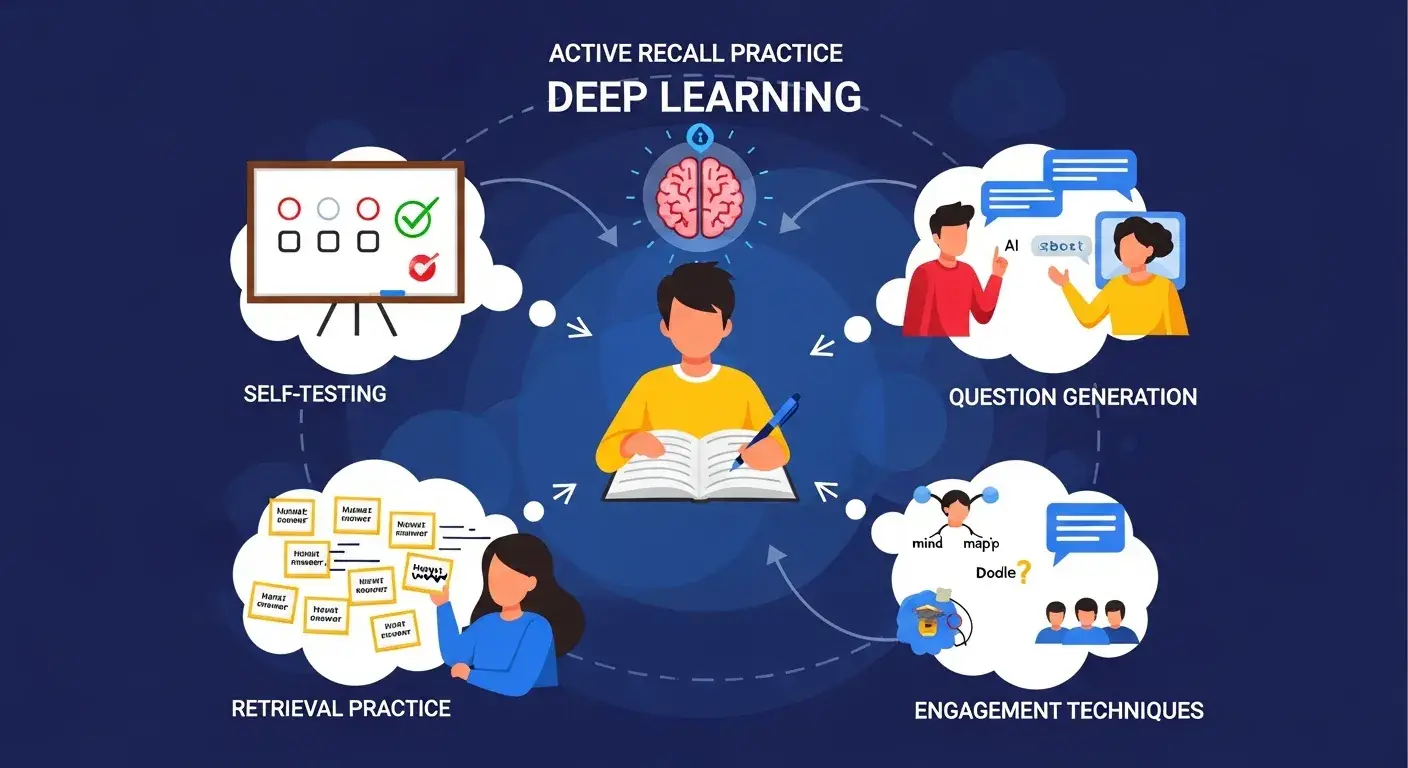
One of the most powerful scientific strategies for long-term memory is active recall, also known as retrieval practice. Instead of passively rereading your notes, actively try to retrieve information from your memory. This could mean:
- Flashcards: Write a question on one side and the answer on the other. Don't just look at the answer; try to recall it first.
- Self-Quizzing: After reading a section, close your book and try to explain what you just learned in your own words. Formulate questions and answer them.
- Mind Mapping: Draw a diagram or concept map from memory, connecting key ideas without referring to your source material.
The effort involved in retrieval practice strengthens the memory trace, making it easier to recall the information later. A 2023 study published in Educational Psychology Review confirmed that consistent retrieval practice significantly outperforms passive review for long-term retention across various subjects.
2. Leverage Spaced Repetition: The Art of Timed Review
Spaced repetition is a highly effective method that involves reviewing information at increasing intervals over time. Instead of cramming, which leads to rapid forgetting, spaced repetition strategically re-exposes you to material just as you're about to forget it.
- How it works: When you successfully recall an item, the next review is scheduled for a longer interval. If you struggle, the interval shortens.
- Benefits: This technique takes advantage of the "spacing effect," a well-documented cognitive phenomenon where learning is more effective when study sessions are spaced out.
- Tools: Digital flashcard apps like Anki or Quizlet are built on spaced repetition algorithms, making it easy to implement this method efficiently.
By incorporating spaced repetition, you ensure that you dedicate your study time to the information you find most challenging, optimizing your learning for true long-term memory. To truly master these concepts, explore our guide on Mastering Active Recall Techniques.
3. Elaboration and Interleaving: Building Richer Memory Networks
Elaboration involves connecting new information to existing knowledge, making it more meaningful and easier to remember. Instead of memorizing isolated facts, ask "why" and "how."
- Ask questions: How does this new concept relate to something I already know? Can I explain it to someone else?
- Analogies and examples: Create your own examples or draw analogies to make abstract concepts concrete.
- Connecting ideas: Look for patterns and relationships between different pieces of information.
Interleaving involves mixing different subjects or topics during a single study session, rather than blocking out long periods for just one. For example, instead of studying math for two hours, you might study math for 30 minutes, then history for 30, then back to math.
- Improved discrimination: This forces your brain to discriminate between different types of problems or concepts, enhancing your problem-solving skills and flexibility.
- Enhanced transfer: It helps you apply knowledge in varied contexts, a crucial aspect of genuine understanding and long-term retention.
These two techniques create a richer, more interconnected web of knowledge in your brain, making it far more robust and accessible than isolated facts.
Beyond the Basics: Advanced Scientific Memory Techniques
To truly learn faster and remember more, consider integrating these advanced approaches that build upon the core principles.
1. Metacognition: Learning About Your Learning
Metacognition is essentially "thinking about thinking" or "knowing about knowing." It involves monitoring and regulating your own learning process. Developing metacognitive skills can drastically improve your study efficiency.
- Self-reflection: Before studying, ask yourself: What do I already know about this topic? What are my learning goals for this session?
- Self-monitoring: During study, ask: Am I truly understanding this, or just skimming? Where am I struggling?
- Self-regulation: Adjust your strategy based on your monitoring. If a method isn't working, try another. If you're consistently making mistakes on a certain topic, dedicate more time to it.
A personal observation: Students who regularly engage in metacognitive practices often identify their knowledge gaps more accurately and adapt their strategies to target those weaknesses, leading to more profound and lasting learning.
2. The Power of Sleep and Memory Consolidation
While not a direct study technique, optimal sleep is a critical scientific strategy for long-term memory. During deep sleep, the brain actively consolidates new memories, moving them from temporary storage (hippocampus) to more permanent storage throughout the cortex.
- Prioritize quality sleep: Aim for 7-9 hours of uninterrupted sleep, especially after learning new material.
- Naps: Short, strategic naps (20-30 minutes) can also aid memory consolidation and improve alertness.
Cutting back on sleep to study more often backfires, as it compromises the very process that turns your learning efforts into lasting knowledge. Research from Sleep Medicine Reviews in 2025 emphasizes the indispensable role of sleep in synaptic plasticity and memory formation.
3. Personalized Adaptive Learning Platforms
A modern trend in effective learning involves personalized adaptive learning platforms. These tools use AI and algorithms to tailor content and review schedules to your individual performance.
- Dynamic pacing: They adjust the difficulty and frequency of material based on your mastery, similar to spaced repetition but with greater sophistication.
- Targeted practice: They identify your specific weaknesses and provide focused exercises to address them, ensuring your learning is always efficient and productive.
These platforms represent the cutting edge in applying scientific strategies for long-term memory by offering a highly individualized path to mastery.
Optimizing Your Environment for Faster Learning and Recall
Your physical and mental environment plays a significant role in your ability to learn faster and remember more. Simple changes can yield substantial benefits.
- Minimize distractions: Create a dedicated study space free from noise, social media, and other interruptions. A focused mind is a more efficient mind.
- Vary your study locations: While minimizing distractions is good, sometimes varying the environment slightly can help. This is known as context-dependent memory. Changing your study location occasionally can lead to more robust memory traces that are less dependent on a single environment for retrieval.
- Stay hydrated and nourished: Your brain needs fuel. Regular water intake and a balanced diet, particularly foods rich in omega-3 fatty acids and antioxidants, support optimal brain function and memory.
- Incorporate physical activity: Exercise increases blood flow to the brain, promoting neurogenesis (the growth of new brain cells) and enhancing cognitive function, including memory. Even a short walk can significantly improve focus and retention.
Frequently Asked Questions About Long-Term Memory
Q: How quickly can I expect to see improvements using these strategies?
A: While individual results vary based on consistency and prior learning habits, many people report noticeable improvements in recall and understanding within a few weeks of consistently applying active recall and spaced repetition. The long-term benefits become more pronounced over months.
Q: Is it possible to improve memory at any age?
A: Absolutely! Neuroplasticity, the brain's ability to reorganize itself by forming new neural connections, persists throughout life. Engaging in challenging learning, using memory strategies, and maintaining a healthy lifestyle can significantly enhance memory function at any age.
Q: What role do mnemonics play in scientific memory strategies?
A: Mnemonics, such as acronyms, rhymes, or the memory palace technique, can be excellent tools for initial encoding of specific information, especially lists or sequences. They are complementary to, rather than a replacement for, active recall and spaced repetition, which ensure that the mnemonically encoded information is retrieved and retained long-term.
Q: Can technology hinder or help my long-term memory?
A: Technology can do both. Over-reliance on external devices to store information (like constantly looking things up) can reduce the need for internal memory encoding. However, technology-enabled tools like spaced repetition apps (e.g., Anki) or adaptive learning platforms are incredibly powerful aids for implementing scientific strategies for long-term memory effectively and efficiently.
Unlock Your Memory Potential
Mastering the art of remembering isn't about having a "good" memory; it's about employing smart, science-backed techniques. By consistently applying scientific strategies for long-term memory like active recall, spaced repetition, and elaboration, you can fundamentally change how you learn and retain information. Your brain is an incredibly powerful tool, and with these methods, you can unlock its full potential to learn faster and remember more.
We encourage you to experiment with these strategies and find what works best for your unique learning style. Share your experiences in the comments below – what techniques have helped you the most?
Further Reading Suggestions:
- Dive deeper into various active recall techniques to refine your retrieval practice.
- For a detailed breakdown of this method, see our article on The Science of Spaced Repetition.
- Explore "Mindful Learning: Enhancing Cognitive Performance" for insights into focus and attention.
Expandable Related Subtopics for Future Updates:
- The Role of Nutrition and Supplements in Memory Enhancement
- Advanced Memory Palaces and Visualization Techniques
- Utilizing AI and Personal Learning Assistants for Memory Optimization