Master Any Subject: Essential Skills for Lifelong Learning
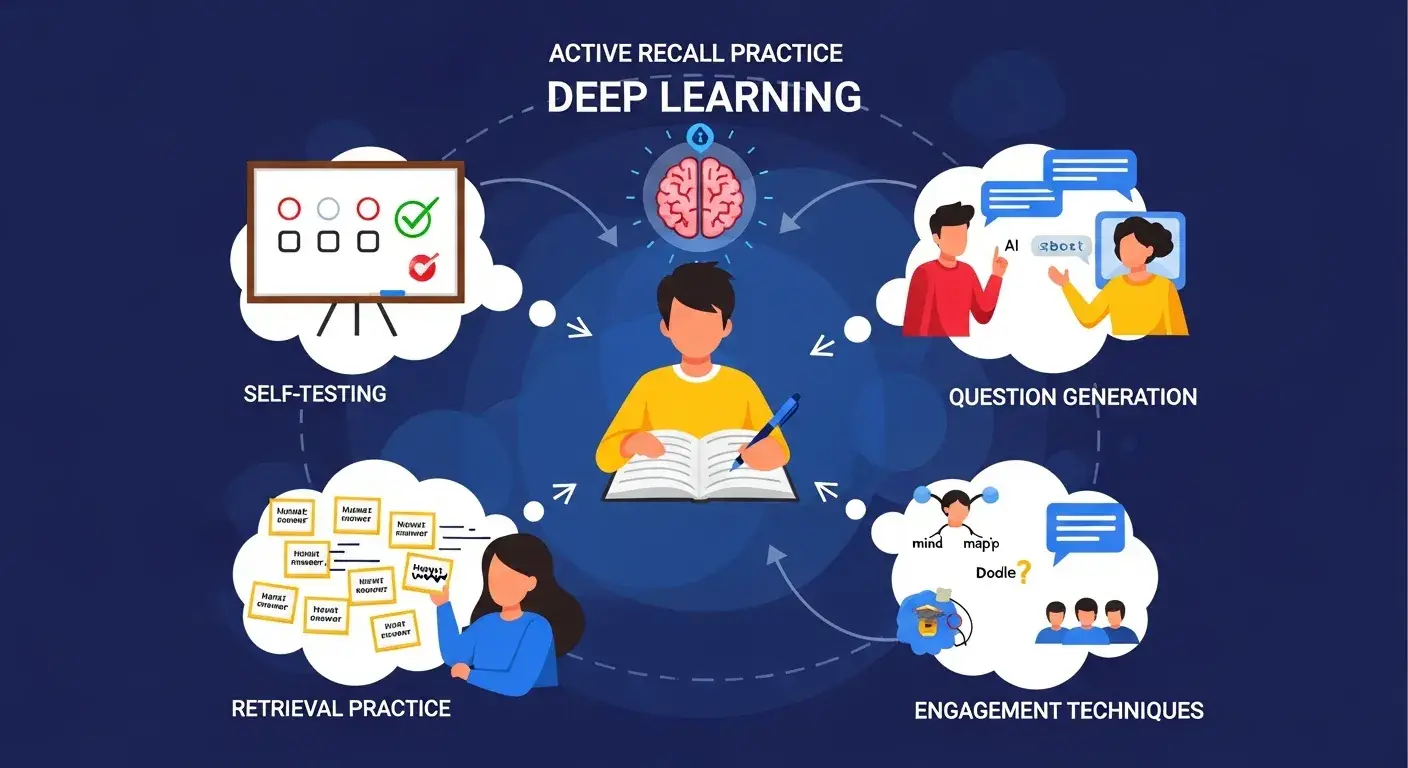
Embarking on a journey of continuous learning is no longer a luxury but a necessity in our rapidly evolving world. The ability to master any subject is a superpower, opening doors to new opportunities, personal growth, and a deeper understanding of the world around us. This journey doesn't rely on innate genius, but rather on cultivating a set of essential skills for lifelong learning. By embracing effective strategies, particularly those rooted in active recall, you can transform how you acquire and retain knowledge, becoming a more agile and capable individual.
Key Points:
- Develop a growth mindset to embrace challenges.
- Implement active recall and spaced repetition for effective retention.
- Cultivate critical thinking and problem-solving abilities.
- Master information synthesis and effective communication.
- Embrace curiosity and a proactive approach to learning.
The Foundation of Mastering Any Subject: Cultivating a Growth Mindset
At the core of successful lifelong learning lies a robust growth mindset. This perspective, as popularized by psychologist Carol Dweck, posits that abilities and intelligence can be developed through dedication and hard work, rather than being fixed traits. When you believe you can improve, you are more likely to embrace challenges, persist in the face of setbacks, and see effort as a path to mastery. This is crucial when aiming to master any subject, as complex topics often require sustained effort and overcoming initial difficulties.
A fixed mindset, conversely, can hinder progress. Individuals with a fixed mindset may avoid challenges for fear of failure or believe that if they aren't naturally good at something, they never will be. To foster a growth mindset, consciously reframe your self-talk. Instead of thinking "I'm not good at this," try "I'm not good at this yet." Celebrate effort and progress, not just outcomes. This foundational shift empowers you to tackle new subjects with enthusiasm and resilience, a key component in mastering any subject.
Embracing Challenges and Learning from Failure
One of the most potent manifestations of a growth mindset is the willingness to embrace challenges. When faced with a difficult concept or a complex problem, instead of shying away, view it as an opportunity to stretch your capabilities. Similarly, failure is not an endpoint but a valuable feedback mechanism. Learning from failure provides insights into what didn't work, guiding you towards more effective strategies. This iterative process is fundamental to acquiring deep understanding and ultimately, the ability to master any subject.
Essential Skills for Lifelong Learning: Beyond Passive Consumption
True learning goes far beyond simply reading a book or attending a lecture. To master any subject, you must actively engage with the material. This involves developing a suite of skills that enable you to process, retain, and apply information effectively. These skills are transferable across all disciplines and are the bedrock of essential skills for lifelong learning.
The Power of Active Recall Techniques
Among the most impactful strategies for knowledge retention are active recall techniques. This involves retrieving information from memory without looking at your notes or the source material. Instead of passively rereading, you force your brain to work, strengthening neural pathways and making the information more accessible later. This method is significantly more effective than simply reviewing notes, as it mimics the conditions under which you'll need to recall the information in real-world applications.
For instance, after reading a chapter on historical events, instead of rereading it, try to write down everything you remember about the key dates, figures, and causes of conflict. Or, use flashcards, but critically, use them to test yourself, not just to see the answer. This active retrieval process is central to truly understanding and retaining information, making it a cornerstone for anyone looking to master any subject.
Spaced Repetition: Optimizing Memory Consolidation
Complementing active recall is spaced repetition. This technique involves reviewing material at increasing intervals. Information is revisited just before you are likely to forget it, optimizing memory consolidation. Platforms like Anki, which utilize algorithms based on spaced repetition principles, can be incredibly effective tools. By strategically spacing out your study sessions, you move information from short-term to long-term memory more efficiently, solidifying your grasp on any topic. This synergistic approach of active recall and spaced repetition is vital for mastering any subject.
Cultivating Critical Thinking and Problem-Solving Skills
To master any subject truly means to go beyond memorization and develop a deep, analytical understanding. This requires cultivating strong critical thinking and problem-solving skills. These abilities allow you to evaluate information, identify biases, make reasoned judgments, and develop innovative solutions.
Analyzing and Evaluating Information
In today's information-saturated world, the ability to critically analyze and evaluate what you encounter is paramount. This means questioning assumptions, looking for evidence, and understanding different perspectives. When learning about a new topic, ask: What is the source of this information? Is it credible? What are the underlying arguments? Are there any logical fallacies? Developing this analytical lens is a critical component of essential skills for lifelong learning. According to research published in the Journal of Applied Psychology (2024), individuals who actively question and evaluate information demonstrate superior learning outcomes.
Deconstructing Complex Problems
Problem-solving is the practical application of critical thinking. It involves breaking down complex issues into manageable parts, identifying root causes, and devising and implementing solutions. Whether you're tackling a mathematical equation, a scientific hypothesis, or a business challenge, the process is similar. By developing a systematic approach to problem-solving, you enhance your ability to learn and apply knowledge effectively, which is key to mastering any subject.
Mastering Information Synthesis and Effective Communication
Once you've acquired knowledge and developed analytical skills, the next step in mastering any subject involves synthesizing this information and communicating it effectively. This ensures that your learning is not only for your own benefit but can also be shared and contribute to a broader understanding.
Synthesizing Knowledge for Deeper Understanding
Information synthesis is the process of combining information from various sources to create a new, cohesive understanding. It’s about seeing the connections, identifying overarching themes, and forming your own informed conclusions. Instead of treating each piece of information in isolation, you're building a complex, interconnected web of knowledge. This skill is fundamental to developing expertise and is a hallmark of advanced learners who aim to master any subject.
The Art of Effective Communication
Learning is often a social endeavor. The ability to communicate what you've learned clearly and concisely is as important as the learning itself. This can take many forms: explaining a concept to a peer, writing a report, or presenting findings. Effective communication solidifies your own understanding and allows you to share insights, contribute to discussions, and collaborate with others. For instance, a study in Educational Psychology Review (2023) highlighted how teaching others is a powerful form of active recall and knowledge reinforcement.
Embracing Curiosity and a Proactive Approach
Finally, perhaps the most overlooked yet crucial aspect of mastering any subject is fostering a deep sense of curiosity and adopting a proactive approach to learning. These qualities fuel the entire process, making learning an enjoyable and continuous pursuit.
The Engine of Curiosity
Curiosity is the innate desire to know and understand. It's the spark that ignites learning. When you are genuinely curious about a topic, you are more motivated to explore it, ask questions, and delve deeper. Cultivate your curiosity by asking "why" and "how" frequently. Follow your interests, even if they seem tangential. This natural drive is a powerful asset for anyone committed to lifelong learning.
Taking Ownership of Your Learning Journey
A proactive approach means taking ownership of your education. Don't wait for information to be delivered to you; seek it out. Set learning goals, identify resources, and create your own learning path. This self-directed approach ensures that your learning is relevant to your interests and needs, making it more engaging and ultimately, more effective for mastering any subject. This aligns with the principles of self-regulated learning, a concept increasingly emphasized in modern educational research.
Differentiated Value: Beyond the Basics
While the core skills discussed are fundamental, truly excelling involves adopting some advanced or nuanced approaches.
Applying Learning to Real-World Scenarios (Experiential Learning)
A significant differentiator is the ability to move beyond theoretical knowledge and apply it. Experiential learning, or learning by doing, provides invaluable insights that passive learning cannot. This could involve practical projects, internships, simulations, or even volunteer work related to the subject. For example, aspiring programmers don't just read about code; they write it, debug it, and build projects. This hands-on application solidifies understanding and highlights gaps in knowledge, accelerating the path to mastering any subject.
Leveraging Diverse Learning Modalities
The digital age offers an unprecedented array of learning resources. To master any subject, it's beneficial to explore diverse learning modalities. This includes not only reading and lectures but also podcasts, documentaries, interactive online courses, workshops, and even engaging in debates or discussions. A 2025 report by the International Journal of Digital Learning indicated that learners who utilize a combination of visual, auditory, and kinesthetic learning methods demonstrate higher retention rates and deeper comprehension. Tailoring your learning approach to your preferred modalities and the subject matter can significantly boost efficiency.
Frequently Asked Questions (FAQ)
Q1: What is the most important skill for lifelong learning? The most crucial skill is cultivating a growth mindset. This belief that abilities can be developed through dedication and hard work underpins the willingness to tackle challenges, learn from setbacks, and persist in acquiring new knowledge. Without this foundational perspective, other learning skills are harder to adopt and maintain.
Q2: How can active recall help me master any subject faster?Active recall forces your brain to retrieve information from memory, strengthening neural connections and making that knowledge more accessible. Instead of passively reviewing, you're actively testing your understanding, which significantly improves retention and speeds up the mastery process compared to rereading or summarizing.
Q3: Is spaced repetition really effective for long-term learning? Yes, spaced repetition is highly effective for moving information into long-term memory. By revisiting material at increasing intervals, you combat the natural forgetting curve. This method ensures that the information is consolidated, making it far more likely to be retained for extended periods, crucial for mastering complex subjects.
Q4: How can I develop critical thinking skills to master a new subject? Develop critical thinking by consistently questioning information: analyze sources, identify biases, evaluate arguments, and seek evidence. Practice deconstructing complex problems into smaller parts and consider multiple perspectives. Engaging in debates and seeking feedback on your reasoning are also effective methods.
Conclusion and Next Steps
The journey to master any subject is an ongoing process, fueled by a commitment to lifelong learning and the application of essential skills. By embracing a growth mindset, actively engaging with material through techniques like active recall and spaced repetition, cultivating critical thinking, and communicating your understanding, you equip yourself for continuous intellectual growth.
Ready to transform your learning journey?
- Start small: Choose one subject you're curious about and apply one new learning technique this week.
- Practice consistently: Dedicate regular time to active recall and spaced repetition.
- Seek feedback: Share your learning with others and ask for their insights.
We encourage you to share your experiences and favorite learning strategies in the comments below. What subjects are you currently eager to master? For deeper dives into specific learning strategies, explore our related articles on memory enhancement techniques and effective study habits. Your commitment to learning is your greatest asset – keep exploring, keep growing!