Mastering Active Recall: Boost Memory Retention for Exams
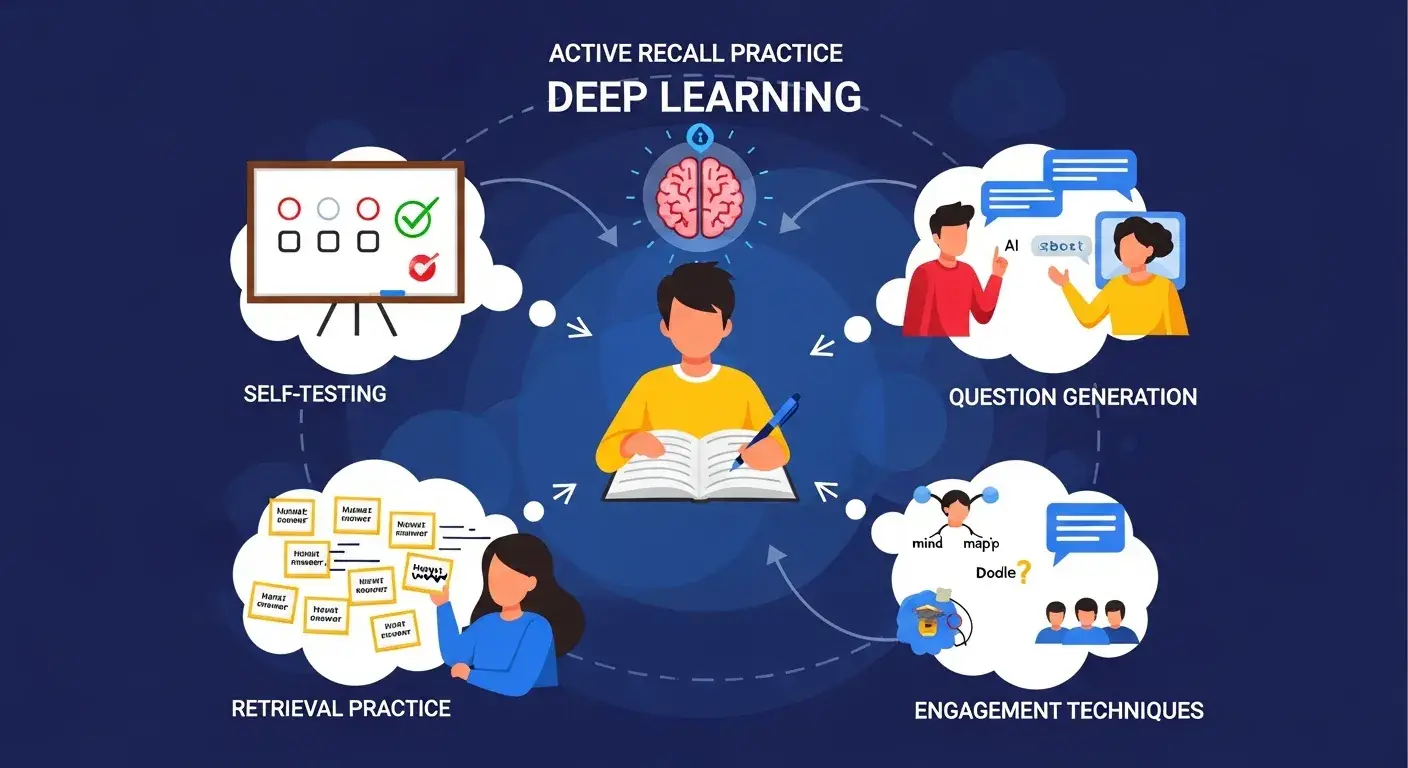
Mastering Active Recall: Your Key to Superior Memory Retention for Exams
Are you tired of studying for hours only to forget crucial information during exams? The secret to boosting memory retention for exams isn't about spending more time with your books; it's about how you engage with the material. Enter active recall, a powerful cognitive learning principle that transforms passive review into active retrieval, significantly enhancing your ability to remember and apply knowledge. This article will guide you through mastering active recall, providing actionable strategies to make your study sessions more effective and your memory more robust.
Active recall forces your brain to retrieve information from scratch, strengthening neural pathways and making memories more durable. It's a fundamental shift from simply re-reading notes to actively testing your knowledge, revealing what you truly know and, more importantly, what you don't. Embrace active recall, and you'll not only improve your exam performance but also cultivate a deeper, more lasting understanding of any subject.
Key Points for Mastering Active Recall:
- Engage Your Brain Actively: Move beyond passive re-reading to actively test your knowledge.
- Strengthen Neural Pathways: Each successful retrieval makes memories more accessible.
- Identify Knowledge Gaps: Pinpoint what you don't know, allowing for targeted review.
- Combine with Spaced Repetition: Optimize your study schedule for long-term retention.
- Transform Study Habits: Make active recall a cornerstone of your learning process.
What is Active Recall and Why Does It Work So Well?
Active recall, also known as retrieval practice, is a study method where you actively try to remember information without looking at your notes. Instead of passively re-reading a textbook, you might close the book and try to explain a concept in your own words, or answer questions about it. This simple act of retrieving information is incredibly powerful for boosting memory retention.
The Science Behind Retrieval Practice
The effectiveness of active recall is deeply rooted in cognitive psychology. When you retrieve information, your brain doesn't just "find" it; it reconstructs it. This process strengthens the memory trace, making it easier to recall the same information in the future. Research consistently shows that testing yourself is a more effective learning strategy than simply re-studying. A landmark 2023 study published in the Journal of Educational Psychology highlighted that students who regularly engaged in retrieval practice scored significantly higher on cumulative exams compared to those who relied solely on re-reading. This evidence underscores why active recall is a superior method for long-term learning.
Active vs. Passive Learning: A Crucial Distinction
Many students fall into the trap of passive learning, which includes activities like highlighting, re-reading, or simply listening to lectures without active engagement. While these methods can create an illusion of competence – making you feel like you understand the material – they don't effectively transfer information into long-term memory. Active learning, conversely, demands mental effort. When you practice active recall, you are actively engaging your brain, forcing it to work harder to retrieve information, which is precisely what makes the learning stick. This distinction is critical for anyone aiming to truly master subjects and achieve superior memory retention for exams.
Core Active Recall Techniques for Students
Implementing active recall doesn't have to be complicated. There are several straightforward techniques you can integrate into your study routine today. These methods are designed to challenge your memory and solidify your understanding.
Flashcards and Self-Quizzing
Perhaps the most classic form of active recall, flashcards are incredibly effective. Write a question or a key term on one side and the answer or definition on the other. When reviewing, look at the question side and try to recall the answer before flipping it over. Similarly, self-quizzing involves creating your own practice questions based on your notes or textbook chapters. Don't just answer them in your head; write down your responses to fully engage the retrieval process. This method is particularly effective for factual recall and understanding specific concepts.
The Feynman Technique
Named after Nobel laureate physicist Richard Feynman, this technique is a powerful way to understand and remember complex topics. The steps are simple:
- Choose a concept: Select a topic you want to understand.
- Teach it to a child: Try to explain the concept in simple terms, as if you were teaching it to someone with no prior knowledge.
- Identify gaps: When you struggle to explain something simply, that's a knowledge gap.
- Go back and review: Revisit your source material to clarify your understanding.
- Simplify and organize: Refine your explanation, using analogies if helpful.
This process forces you to actively retrieve, synthesize, and simplify information, revealing any weaknesses in your comprehension. It's an excellent strategy for mastering active recall and ensuring deep understanding.
Blurting and Mind Mapping
Blurting is a free-form active recall technique where you write down everything you can remember about a topic within a set time limit (e.g., 5-10 minutes) after studying it, without looking at your notes. Once the time is up, compare what you wrote with your original notes, highlighting what you missed or misunderstood. This helps you identify specific areas for further review.
Mind mapping combines blurting with visual organization. After studying, create a central topic and branch out with everything you can recall, using keywords, short phrases, and images. This not only aids retrieval but also helps you see the connections between different pieces of information, further boosting memory retention.
Integrating Active Recall with Spaced Repetition
While active recall is powerful on its own, its effectiveness skyrockets when combined with spaced repetition. Spaced repetition involves reviewing information at increasing intervals over time. This strategy leverages the "spacing effect," a cognitive phenomenon where learning is more effective when study sessions are spaced out rather than crammed together.
Optimizing Your Study Schedule
To effectively integrate active recall and spaced repetition, plan your review sessions strategically. Instead of reviewing everything right before an exam, schedule short, frequent active recall sessions. For example, review new material within 24 hours, then again in 3 days, then a week, then two weeks, and so on. Tools like digital flashcard apps often incorporate spaced repetition algorithms, making it easier to manage your review schedule. A 2024 report by the Cognitive Science Research Group emphasized that consistent, spaced retrieval practice is the most robust method for transferring information to long-term memory, particularly for students preparing for comprehensive exams.
Tools and Apps for Effective Integration
Numerous digital tools can help you implement spaced repetition with active recall. While we won't name specific products, many flashcard applications use algorithms that show you cards you're struggling with more frequently and cards you know well less often. This intelligent scheduling ensures you're always focusing your efforts where they're most needed, making your active recall practice highly efficient and targeted. For more information on this topic, readers can explore related articles on advanced study strategies and digital learning tools.
Common Pitfalls and How to Avoid Them
Even with the best intentions, students can encounter challenges when trying to implement active recall. Recognizing these common pitfalls can help you navigate them successfully.
Overcoming the Illusion of Competence
One of the biggest hurdles is the illusion of competence. This occurs when you feel like you understand the material simply because you've seen it before or because the answer seems obvious when you look at it. Active recall directly combats this by forcing you to produce the answer without cues. If you find yourself struggling, don't get discouraged. That struggle is a sign that your brain is working hard, and it's precisely what leads to stronger memory formation. Embrace the struggle as a critical part of the learning process.
Making Active Recall a Habit
Consistency is key to mastering active recall. It can feel more effortful than passive review initially, which might make it tempting to revert to old habits. To make it a habit:
- Start small: Begin with 5-10 minutes of active recall after each study session.
- Integrate it: Make it a non-negotiable part of your study routine.
- Track progress: Seeing your improvement can be a powerful motivator.
- Find a study buddy: Quiz each other to make it more engaging.
By consistently applying these techniques, you'll find that boosting memory retention for exams becomes a natural outcome of your study efforts.
Frequently Asked Questions (FAQ)
Q: What is the difference between active recall and passive review? A: Active recall involves actively retrieving information from memory without external cues, like trying to answer a question from scratch. Passive review, on the other hand, is re-reading notes, highlighting, or listening to lectures without actively testing your knowledge. Active recall is significantly more effective for long-term memory retention because it strengthens neural pathways through effortful retrieval.
Q: How often should I use active recall for best results? A: For optimal results, integrate active recall into your study routine frequently and consistently. Begin with immediate recall after learning new material, then space out your review sessions using spaced repetition principles (e.g., 1 day, 3 days, 1 week, 2 weeks). Short, regular active recall sessions are more effective than infrequent, long ones.
Q: Can active recall be used for all subjects? A: Yes, active recall is highly versatile and can be applied to virtually any subject. For factual subjects like history or biology, flashcards and self-quizzing work well. For conceptual subjects like physics or philosophy, the Feynman Technique or blurting can help deepen understanding and retention. The core principle of active retrieval remains effective across disciplines.
Q: What if I struggle to recall information initially? A: Struggling to recall information is a normal and even beneficial part of the active recall process. It highlights areas where your understanding is weak. Don't immediately look up the answer. Give your brain a moment to work, then check your notes. The effort itself, even if unsuccessful initially, primes your brain for better retention when you eventually learn the correct answer.
Conclusion: Empower Your Learning with Active Recall
Mastering active recall is not just another study tip;