Mastering Active Recall: Boost Memory Retention for Exams
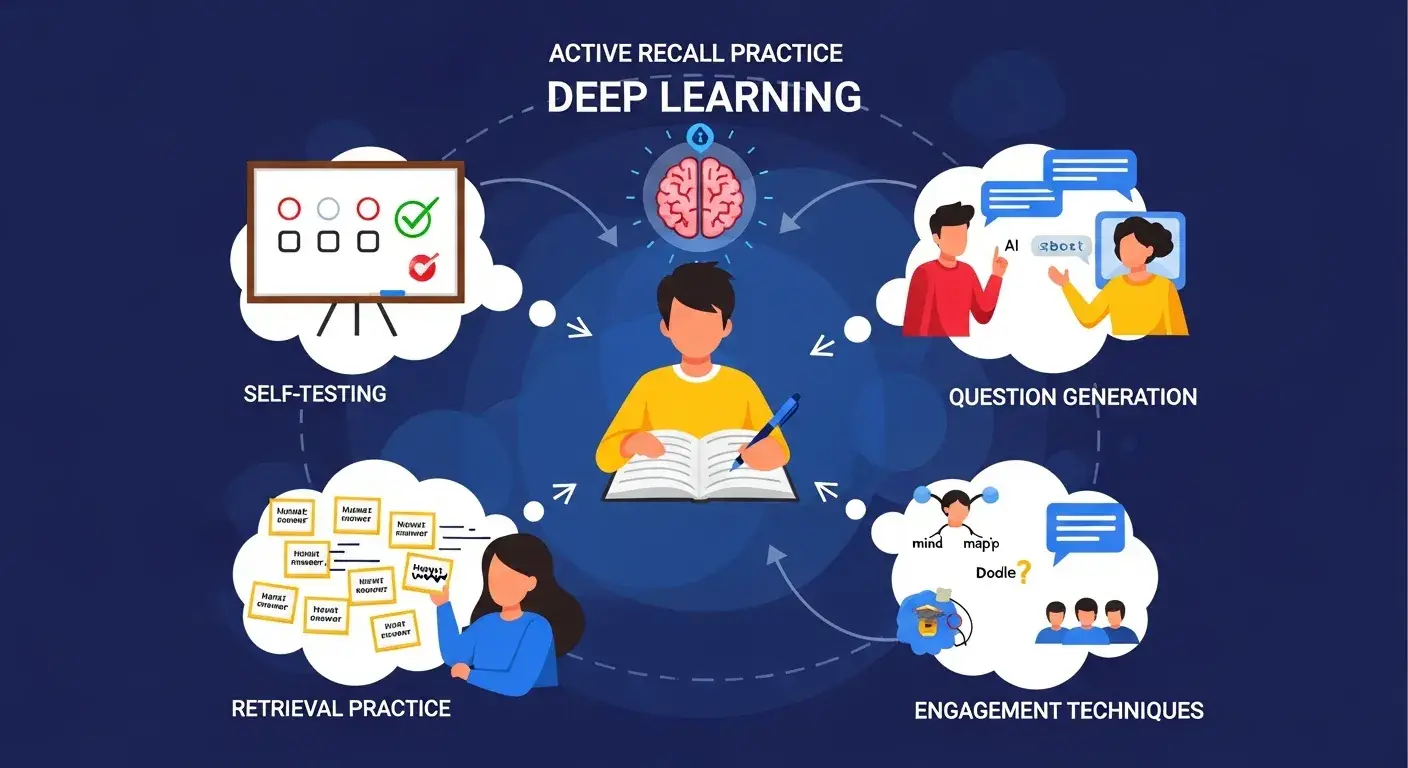
Mastering Active Recall: Boost Memory Retention for Exams
Preparing for exams can often feel like an uphill battle against forgetting. Many students spend countless hours rereading notes or passively highlighting textbooks, only to find the information elusive when test day arrives. This common struggle highlights a fundamental flaw in traditional study methods. Mastering active recall offers a powerful solution, transforming how you interact with information and significantly boosting your memory retention for exams. It's not just about studying harder; it's about studying smarter by actively retrieving information from your brain rather than passively reviewing it.
Active recall, also known as retrieval practice, is a cognitive learning strategy that involves deliberately bringing information to mind from memory. This process strengthens neural pathways, making it easier to access that information again in the future. By consistently challenging your brain to retrieve facts, concepts, and formulas, you're not only testing your knowledge but also reinforcing it. This article will guide you through the principles of active recall, provide practical techniques, and offer insights into how you can integrate this highly effective strategy into your exam preparation to achieve superior results.
Key Points for Mastering Active Recall
- Self-Testing is Key: Regularly quiz yourself without notes to identify knowledge gaps.
- Flashcards are Your Friend: Create and use them effectively for quick, targeted retrieval practice.
- Explain Concepts Aloud: Articulate what you've learned to solidify understanding and memory.
- Combine with Spaced Repetition: Optimize review intervals to maximize long-term retention.
- Identify Knowledge Gaps: Pinpoint areas needing more focus, making your study time more efficient.
Understanding Active Recall: The Science Behind Better Memory
Active recall is rooted in robust cognitive psychology research, demonstrating its superior effectiveness over passive study methods. When you engage in active recall, you're essentially practicing the act of remembering, which is precisely what you need to do during an exam. This process forces your brain to work harder, creating stronger, more durable memory traces. Unlike simply rereading, which can create an illusion of knowing, active recall provides immediate feedback on what you truly understand and what still needs work. This immediate feedback loop is crucial for efficient learning and boosting memory retention.
The "testing effect" is a well-documented phenomenon that explains why active recall is so potent. Research consistently shows that testing oneself not only assesses learning but also enhances it. Each time you successfully retrieve a piece of information, that memory becomes more accessible and resistant to forgetting. Even failed retrieval attempts can be beneficial, as they signal a knowledge gap, prompting you to revisit the material with a more focused approach. This makes active recall an indispensable tool for effective exam preparation.
Core Active Recall Techniques for Effective Learning
Integrating active recall into your study routine doesn't require complex tools or methods. Many simple yet powerful techniques can be employed immediately to enhance your learning. The goal is always to prompt your brain to retrieve information without looking at your notes.
Flashcards and Self-Quizzing
One of the most classic and effective active recall methods is using flashcards. Write a question or concept on one side and the answer or explanation on the other. Regularly cycle through these cards, trying to recall the information before flipping them over. Digital flashcard apps, like Anki, can even incorporate spaced repetition, further optimizing your review schedule. Beyond flashcards, simply closing your textbook and trying to recall key definitions, formulas, or steps in a process is a powerful form of self-quizzing.
The Feynman Technique
Named after Nobel laureate Richard Feynman, this technique involves explaining a concept in simple terms as if you were teaching it to someone else (or even a rubber duck!). If you struggle to explain a concept clearly and concisely, it reveals gaps in your understanding. This method not only forces active recall but also deepens your comprehension, making it an excellent strategy for mastering active recall for complex subjects.
Practice Questions and Past Papers
Working through practice questions and past exam papers is perhaps the most direct application of active recall for exam preparation. These resources simulate the actual exam environment, challenging you to retrieve information under pressure. Don't just check the answers; try to understand why you got something wrong and then re-explain the correct answer to yourself. This iterative process is vital for solidifying knowledge and identifying areas for improvement.
Integrating Active Recall into Your Exam Preparation Strategy
To truly maximize the benefits of active recall, it needs to be a consistent part of your study strategy, not just a last-minute cramming tool. A structured approach can help you weave it seamlessly into your routine.
Combine with Spaced Repetition
Spaced repetition is the perfect partner for active recall. It involves reviewing material at increasing intervals over time. After actively recalling a piece of information, you schedule its review for a later date. If you recall it easily, the next review interval is extended. If you struggle, the interval is shortened. This intelligent scheduling ensures you revisit information just as you're about to forget it, making your retrieval practice highly efficient for long-term memory retention. For more information on this topic, readers can explore related articles on optimizing study schedules.
Create Retrieval Cues
When taking notes, instead of just summarizing, try to formulate questions that your notes answer. Later, you can cover your notes and use these questions as retrieval cues. For example, if you're learning about the causes of World War I, your note might be "What were the main long-term causes of WWI?" followed by the answer. This proactive approach sets you up for effective active recall sessions.
The Power of Elaboration
Beyond just recalling facts, elaborate on them. How does this concept relate to others? Can you provide an example? Can you think of a counter-example? This deeper processing, while not strictly active recall, enhances the strength of the memory trace and makes it easier to retrieve later. A 2024 study published in the Journal of Educational Psychology highlighted that students who combined retrieval practice with elaborative rehearsal