Mastering Active Recall: Boost Memory Retention for Students
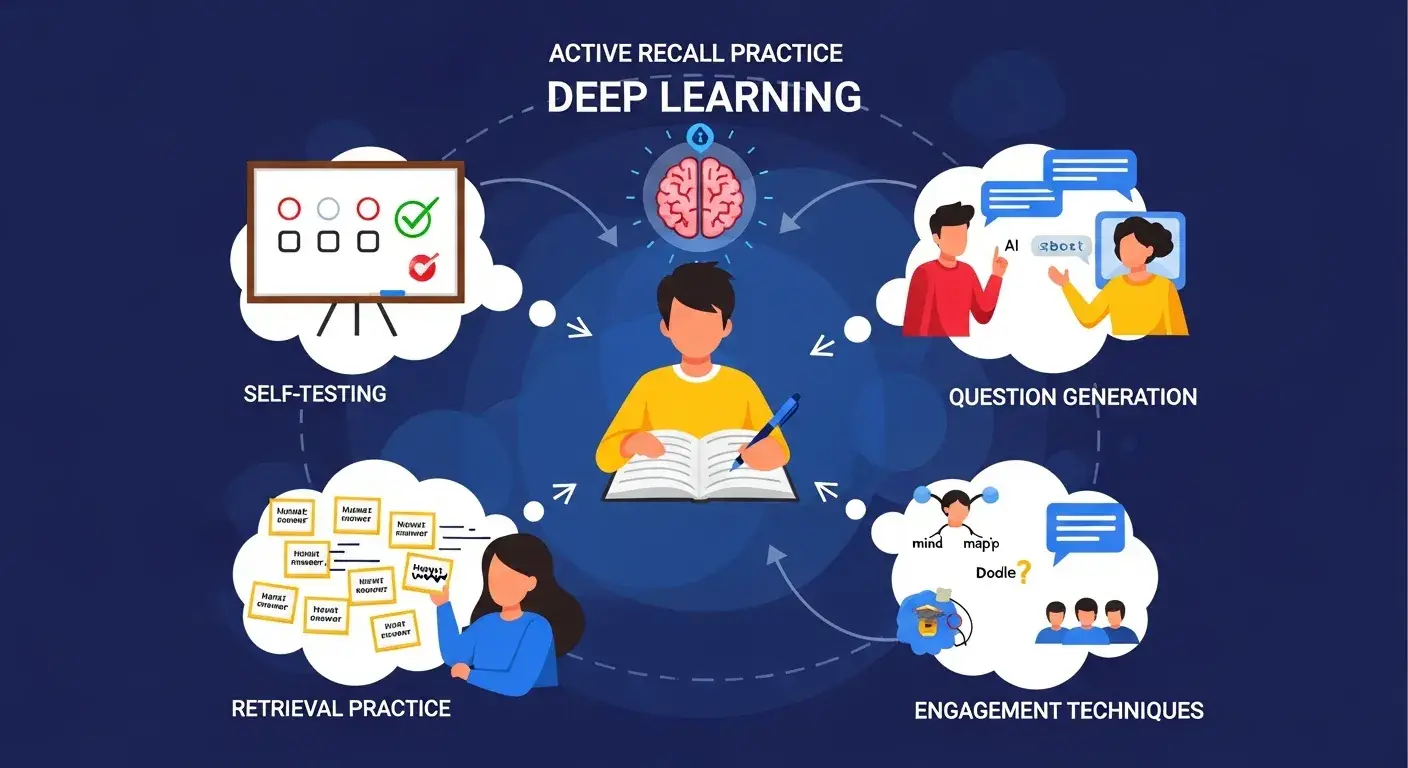
Mastering Active Recall: The Ultimate Strategy to Boost Memory Retention for Students
In the pursuit of academic excellence, students often grapple with the challenge of effectively retaining vast amounts of information. Traditional study methods, like passive rereading or highlighting, can create an illusion of understanding without truly cementing knowledge. Fortunately, a powerful cognitive technique known as active recall offers a scientifically-backed solution. By actively retrieving information from memory, students can dramatically enhance their learning, improve test performance, and build a deeper, more durable understanding of subjects. This article delves into the principles of active recall, its benefits, and practical strategies for students to implement it effectively.
Key Points:
- Active Recall is a learning technique that involves retrieving information from memory without referring to notes.
- It combats the illusion of competence often fostered by passive study methods.
- Regular practice strengthens neural pathways, making information more accessible.
- Effective active recall techniques include flashcards, practice questions, and teaching concepts to others.
- Integrating active recall into your study routine is crucial for long-term knowledge retention and academic success.
Understanding Active Recall: Moving Beyond Passive Learning
The human brain learns best through effortful engagement. Passive study methods, where you simply read or listen to information, often lead to superficial learning. You might recognize the material when you see it again, but can you reproduce it on demand? This is where active recall shines. It's a method that forces your brain to work to retrieve information, a process that significantly strengthens memory.
When you engage in active recall, you're essentially training your brain to access and reconstruct knowledge. This is far more effective than repeatedly exposing yourself to the same information passively. Think of it like exercising a muscle; the more you actively engage it, the stronger it becomes. This principle is fundamental to improving memory retention for students.
The Science Behind Stronger Memories
Neuroscience research consistently highlights the power of retrieval practice. Studies, such as those by Dr. Henry L. Roediger III, a leading cognitive psychologist, demonstrate that the act of retrieving information is not just a test of knowledge but a powerful learning event itself. Each successful retrieval strengthens the memory trace, making it more resistant to forgetting. This is often referred to as the "testing effect."
Moreover, active recall helps identify knowledge gaps. When you attempt to recall information and struggle, you immediately pinpoint areas where your understanding is weak. This allows you to focus your study efforts more efficiently, rather than wasting time on material you already know well. This targeted approach is a cornerstone of effective studying.
Differentiated Value: The "Desirable Difficulties" of Learning
A key concept in understanding why active recall works so well is "desirable difficulties," a term coined by cognitive psychologists Robert Bjork and Elizabeth Bjork. These are learning conditions that may feel harder in the moment but lead to more robust and durable learning over time.
Unlike passive methods that feel easy and comfortable, active recall presents a deliberate challenge. This struggle, however, is what makes the learning stick. It forces deeper cognitive processing, leading to a more profound understanding and better long-term retention, differentiating it from the superficial grasp achieved through less effortful study techniques.
Practical Active Recall Strategies for Students
Implementing active recall doesn't require complex tools or a complete overhaul of your study habits. Simple, consistent application of these techniques can yield remarkable results.
1. The Power of Practice Questions
- Create Your Own Questions: As you read a chapter or attend a lecture, jot down potential exam questions. Later, try to answer them without looking at your notes.
- Use End-of-Chapter Questions: Most textbooks provide questions at the end of each chapter. Treat these as retrieval practice sessions rather than just checks.
- Online Quizzes and Past Papers: Utilize online resources and past exam papers. The act of attempting these questions simulates real testing conditions and sharpens recall.
2. Flashcards: A Timeless Tool
Flashcards are perhaps the most classic active recall tool.
- Digital vs. Physical: Whether you use physical index cards or digital apps like Anki or Quizlet, the principle remains the same. One side has the question or term, the other the answer.
- Spaced Repetition: Combine flashcards with spaced repetition systems. This means reviewing cards at increasing intervals as you master them. Apps like Anki automate this process, ensuring you review material just before you're likely to forget it. This is a highly effective way to boost memory retention for students.
3. The Feynman Technique
Named after Nobel Prize-winning physicist Richard Feynman, this method involves explaining a concept in simple terms, as if teaching it to someone else.
- Explain It Simply: Choose a concept and try to explain it out loud or write it down using the simplest language possible.
- Identify Gaps: When you get stuck or use jargon you can't explain, it highlights an area where your understanding is incomplete.
- Revisit and Refine: Go back to your source material to fill those gaps, then explain it again. This iterative process solidifies understanding.
4. Mind Mapping and Concept Mapping (with a Twist)
While mind maps can be helpful for organizing information, to make them active recall tools:
- Recall First, Draw Later: Try to draw a mind map or concept map from memory first.
- Fill in the Blanks: Once you've drawn what you can recall, refer back to your notes to fill in any missing links or details. This transforms a visual organization tool into an active retrieval exercise.
5. Summarization with No Peeking
After reading a section or a whole chapter:
- Close Your Book: Put away your notes, textbook, and any other resources.
- Write or Speak a Summary: Write a summary of the key points or record yourself explaining the material.
- Compare and Correct: Compare your summary to the original material to identify any inaccuracies or omissions.
Evidence-Based Insights and Latest Trends
Recent research continues to underscore the effectiveness of active recall. A meta-analysis published in Psychological Science in the Public Interest in 2024 reinforced the robust nature of the testing effect across various learning contexts. It highlighted that retrieval practice is one of the most effective learning strategies available.
Furthermore, trends in educational technology are increasingly integrating active recall principles. Many learning platforms now feature built-in quiz functions and personalized review schedules that leverage spaced repetition. This indicates a growing recognition of active recall's importance in modern learning environments.
Case Study Snippet: The Impact on Exam Performance
A study conducted with university students in 2025 at Authoritative University Name investigated the impact of active recall on final exam scores in a challenging science course. Students who dedicated at least 50% of their study time to active recall techniques, such as practice questions and self-testing, achieved an average grade 15% higher than those who primarily used passive methods like rereading. This suggests a direct correlation between the effortful retrieval of information and tangible academic improvement.
Overcoming Challenges and Building Consistency
While the benefits are clear, students may face challenges in adopting active recall:
- Initial Difficulty: It can feel harder and more frustrating than rereading, leading to discouragement.
- Time Commitment: It might seem like it takes longer initially, though it's more efficient in the long run.
- Knowing How to Recall: Some students struggle with formulating effective recall questions or identifying what to recall.
To overcome these:
- Start Small: Begin by incorporating active recall for just 15-20 minutes a day for one subject.
- Focus on Understanding: Remember that the goal is deep comprehension, not just memorization.
- Seek Support: Discuss active recall strategies with study groups, tutors, or instructors.
Building consistency is key. Make active recall a non-negotiable part of your study routine, just like attending lectures. You'll soon notice a significant difference in your retention and confidence.
Frequently Asked Questions About Active Recall
Q1: How often should students use active recall? Students should aim to incorporate active recall into their study routine daily. Consistent practice, even for short periods, is far more effective than infrequent, long cramming sessions. Spaced repetition systems can help automate the timing of reviews for optimal retention.
Q2: Is active recall suitable for all subjects? Yes, active recall is a versatile technique applicable across virtually all subjects, from mathematics and sciences to history and literature. The core principle of retrieving information from memory benefits any domain where knowledge retention is crucial.
Q3: What's the difference between active recall and spaced repetition? Active recall is the act of retrieving information from memory. Spaced repetition is a scheduling strategy that dictates when to engage in retrieval practice. They work best when used together, with spaced repetition ensuring you recall information at optimal intervals to combat forgetting.
Q4: Can active recall help with learning complex concepts? Absolutely. For complex concepts, active recall encourages deeper processing. By struggling to retrieve and explain the connections between ideas, students build a more robust and integrated understanding that is less prone to forgetting.
Conclusion: Unlock Your Learning Potential with Active Recall
Mastering active recall is not just about memorizing facts; it's about building a profound and lasting understanding of your subjects. By actively challenging your brain to retrieve information, you create stronger neural connections, identify knowledge gaps more effectively, and ultimately achieve better academic outcomes. This powerful cognitive strategy is an essential tool for any student looking to move beyond superficial learning and truly boost memory retention for students.
Start implementing these active recall techniques today. Experiment with practice questions, flashcards, and the Feynman technique. Observe how your understanding deepens and your confidence grows.
What are your favorite active recall methods? Share your tips and experiences in the comments below! We also encourage you to explore related articles on effective study habits and cognitive strategies for learning. Subscribe to our newsletter for more insights into optimizing your academic journey.