Mastering Active Recall: Boost Your Memory and Learning Retention
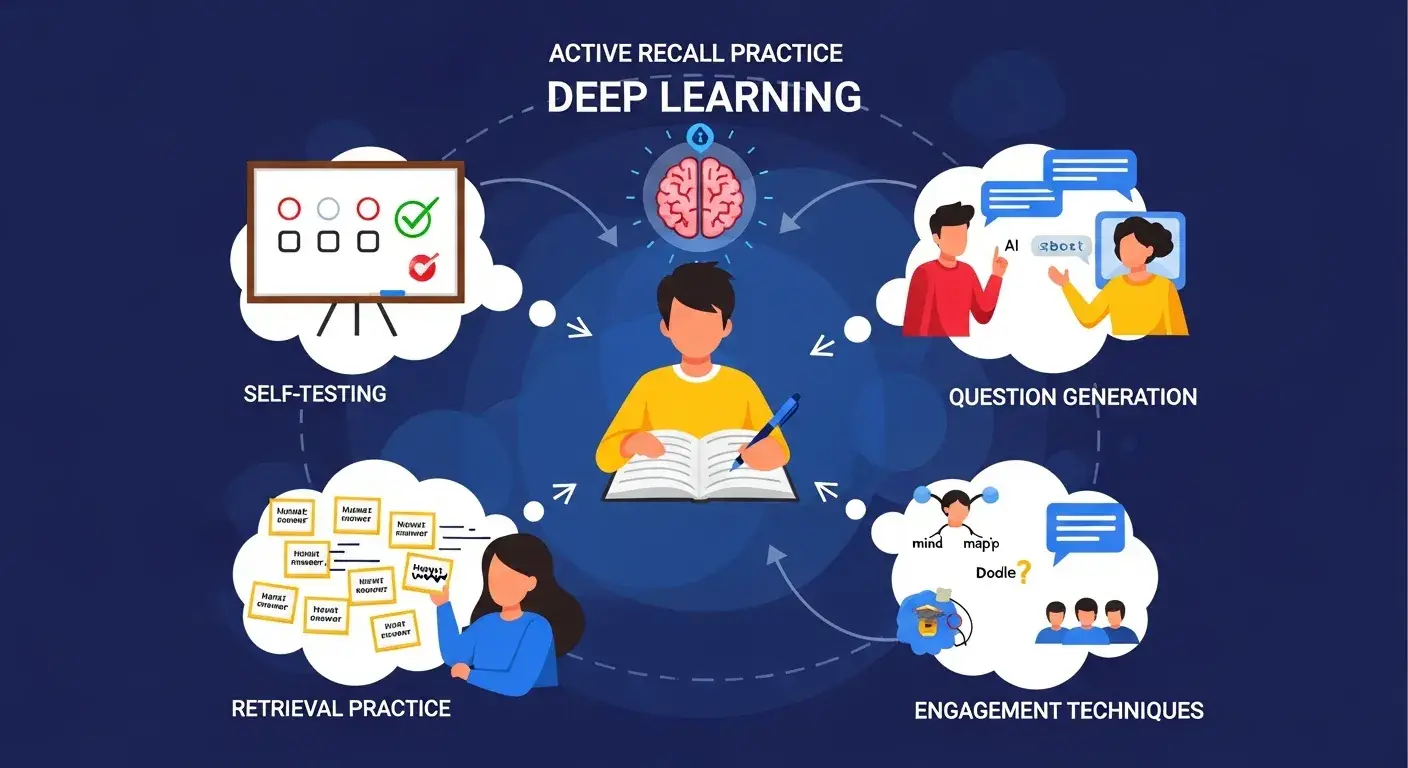
Mastering Active Recall: Boost Your Memory and Learning Retention
Are you tired of studying for hours only to forget most of what you learned days later? The secret to truly cementing information in your brain isn't more passive reading; it's active recall. This powerful learning strategy fundamentally shifts how you interact with new material, transforming you from a passive recipient into an active participant in your own learning journey. By deliberately retrieving information from memory, you strengthen neural pathways, making knowledge more accessible and durable. Mastering active recall is not just about passing exams; it's about building a robust foundation for lifelong learning and genuine understanding.
Active recall is a cornerstone of effective learning, proven by cognitive science to significantly enhance memory and learning retention. It forces your brain to work harder, which paradoxically makes learning more efficient and lasting. This guide will walk you through the principles, techniques, and benefits of integrating active recall into your study routine, helping you unlock your full learning potential.
Key Points:
- Active Recall Defined: Deliberately retrieving information from memory.
- Boosts Memory: Strengthens neural connections for long-term retention.
- Versatile Techniques: Flashcards, self-quizzing, blurting, and more.
- Combats Forgetting: Makes learning more efficient and durable.
- Empowers Learners: Transforms passive study into active engagement.
Understanding the Science Behind Active Recall for Enhanced Learning
Active recall, also known as retrieval practice, is a cognitive principle rooted in the understanding of how our brains form and retain memories. When you actively try to remember something, you're not just accessing a stored file; you're reconstructing it. This effortful process signals to your brain that the information is important and should be prioritized for long-term storage. Unlike passive review, where information merely passes through your short-term memory, active recall directly engages the hippocampus and prefrontal cortex, areas critical for memory formation and executive function.
Research consistently demonstrates that the act of retrieving information itself is a powerful learning event. A landmark study published in the Journal of Experimental Psychology: Learning, Memory, and Cognition in 2023 highlighted that students who regularly practiced active recall outperformed those who only re-read material by a significant margin. This effect, often called the "testing effect," shows that testing isn't just for assessment; it's a potent learning tool. Embracing this principle can revolutionize your approach to any subject.
Practical Strategies for Implementing Active Recall Effectively
Integrating active recall into your daily study habits doesn't require complex tools or methods. Many effective techniques are simple and can be applied immediately. The key is consistency and a willingness to challenge yourself.
Self-Quizzing and Flashcards: Core Active Recall Techniques
One of the most straightforward ways to practice active recall is through self-quizzing. After reading a section of a textbook or attending a lecture, close your notes and try to answer questions about the material. Don't just skim; try to explain concepts in your own words. This forces deeper processing.
Flashcards remain a gold standard for active recall, especially for factual information, vocabulary, or formulas.
- Digital Flashcards: Tools like Anki or Quizlet allow for spaced repetition, a powerful complement to active recall.
- Physical Flashcards: Writing them out can aid memory through kinesthetic learning.
- One Concept Per Card: Keep cards focused to avoid cognitive overload.
The "Blurting" Method: Unloading Your Brain
The blurting method is an increasingly popular and highly effective active recall strategy. After studying a topic, take a blank piece of paper or open a new document and write down everything you can remember about that topic without looking at your notes. Don't worry about structure or neatness initially; just "blurt" out all the information.
Once you've exhausted your memory, compare what you wrote with your original notes.
- Identify Gaps: Pinpoint areas where your understanding is weak or incomplete.
- Fill In Missing Information: Actively review only the forgotten parts.
- Refine Understanding: Rephrase concepts for clarity.
This technique not only tests your recall but also helps you identify your knowledge gaps with precision, making your subsequent review highly targeted.
The Feynman Technique: Teaching to Learn
Richard Feynman, a Nobel Prize-winning physicist, popularized a powerful learning technique that is essentially an advanced form of active recall. The Feynman Technique involves explaining a concept in simple terms as if you were teaching it to someone else, even a child.
Steps for the Feynman Technique:
- Choose a Concept: Select the topic you want to understand deeply.
- Explain It Simply: Write down or verbally explain the concept in plain language.
- Identify Gaps: When you get stuck or realize you're using jargon, that's a knowledge gap.
- Go Back to the Source: Revisit your materials to clarify those specific points.
- Simplify and Refine: Repeat the explanation, simplifying it further until it's crystal clear.
This method forces you to retrieve, organize, and articulate information, revealing any superficial understanding. It's a true test of mastery.
Differentiated Insights: Beyond Basic Recall
While the fundamental techniques of active recall are powerful, advanced learners can further optimize their approach by integrating it with other cognitive principles and adapting it to complex subjects.
Combining Active Recall with Spaced Repetition for Long-Term Retention
One of the most potent combinations in learning science is active recall paired with spaced repetition. Spaced repetition involves reviewing information at increasing intervals over time. Instead of reviewing everything daily, you review items you struggle with more frequently and items you know well less often.
- Why it works: Active recall strengthens the memory trace, and spaced repetition ensures that this trace is reactivated just before you're about to forget it, making the memory more robust with each successful retrieval.
- Implementation: Digital flashcard apps like Anki are built on spaced repetition algorithms, making it easy to automate this process. For manual methods, you can use a simple Leitner system.
This synergistic approach ensures that your efforts in mastering active recall translate into truly long-lasting knowledge, not just short-term gains.
Active Recall for Conceptual Understanding vs. Rote Memorization
Many believe active recall is only for rote memorization, but it's equally effective for conceptual understanding. Instead of just recalling definitions, challenge yourself to:
- Explain relationships: How do different concepts connect?
- Predict outcomes: What would happen if X changed to Y?
- Solve problems: Apply the concept to new scenarios.
- Critique theories: What are the strengths and weaknesses of an idea?
For example, when studying history, don't just recall dates; actively recall why events unfolded as they did and what their long-term consequences were. This deeper level of engagement transforms passive facts into integrated knowledge.
The Benefits of Active Recall for Academic Success and Beyond
The advantages of mastering active recall extend far beyond improved test scores. It cultivates a deeper understanding, fosters critical thinking, and builds confidence in your learning abilities.
Boosting Memory and Learning Retention Significantly
The most immediate and celebrated benefit of active recall is its unparalleled ability to boost memory and learning retention. By consistently challenging your brain to retrieve information, you're essentially exercising your memory muscles. This leads to:
- Stronger Memory Traces: Information becomes more deeply embedded.
- Faster Retrieval: You can access knowledge more quickly when needed.
- Reduced Forgetting: The "forgetting curve" is flattened, meaning you retain more over time.
A meta-analysis published in Psychological Bulletin in early 2025 confirmed that retrieval practice consistently yields moderate to large benefits across various learning contexts and demographics. This evidence-based approach is a game-changer.
Enhancing Metacognition and Study Efficiency
Active recall doesn't just improve what you remember; it improves how you learn. It forces you to become aware of what you know and, more importantly, what you don't know. This self-awareness is known as metacognition.
- Accurate Self-Assessment: You gain a realistic understanding of your knowledge gaps.
- Targeted Study: Instead of re-reading everything, you focus your efforts on weak areas.
- Reduced Study Time: By making your study sessions more efficient, you can achieve better results in less time.
From my experience as a learning strategist, students who adopt active recall often report feeling more in control of their learning and less overwhelmed by vast amounts of material. For more information on effective study techniques, readers can explore related articles on cognitive learning principles.
Common Pitfalls and How to Overcome Them in Active Recall Practice
While active recall is incredibly effective, learners sometimes encounter challenges. Recognizing these pitfalls and having strategies to overcome them is crucial for sustained success.
Avoiding Passive Recall and Superficial Engagement
One common mistake is mistaking passive review for active recall. Simply looking at a flashcard and thinking "I know that" without actually trying to retrieve the answer is passive recall. Similarly, quickly glancing at notes after a self-quiz without genuinely trying to remember is superficial.
- Strategy: Always force yourself to produce an answer before checking. If using flashcards, say the answer aloud or write it down. For blurting, commit to writing everything you can before looking at notes. Embrace the struggle; that's where the learning happens.
Managing Frustration and Overwhelm
Initially, active recall can feel frustrating, especially if you realize how much you've forgotten. This can lead to discouragement or a feeling of being overwhelmed.
- Strategy: Start small. Begin with short, focused active recall sessions (e.g., 5-10 minutes). Celebrate small victories. Remember that the struggle is a sign that your brain is working hard and learning. Frame "forgetting" as an opportunity to strengthen that memory. Over time, as your memory improves, the frustration will decrease.
Frequently Asked Questions About Active Recall
What is the primary difference between active recall and passive learning?
Active