Mastering Active Recall: Proven Techniques for Better Memory Retention
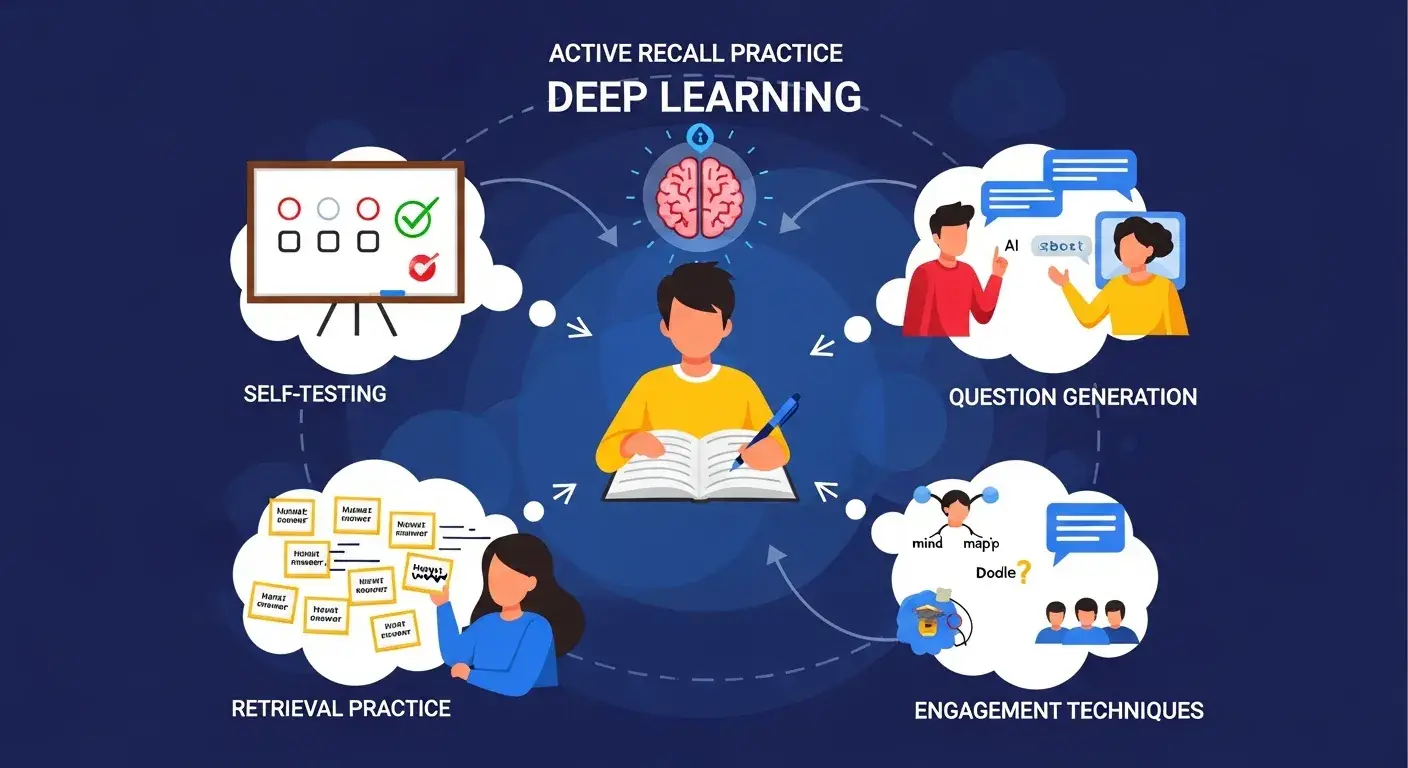
Mastering Active Recall: Proven Techniques for Better Memory Retention
In an age of information overload, the ability to effectively learn and retain knowledge is more valuable than ever. Active recall stands out as one of the most powerful cognitive learning principles for achieving superior memory retention. Unlike passive review, which often gives a false sense of familiarity, active recall actively challenges your brain to retrieve information from scratch. This process strengthens neural pathways, making memories more robust and accessible over time. By consistently applying these proven techniques, you can transform your study habits and achieve long-term knowledge mastery.
This guide will delve into the science behind active recall, explore practical strategies you can implement today, and provide insights into integrating this method for optimal learning outcomes. Whether you're a student, a professional, or a lifelong learner, mastering active recall is a game-changer for enhancing your cognitive abilities and ensuring better memory.
Key Points for Mastering Active Recall
- Engage Your Brain: Actively retrieve information rather than passively re-reading.
- Strengthen Memory: Each successful recall attempt reinforces neural connections.
- Identify Gaps: Pinpoint what you don't know, allowing targeted study.
- Boost Confidence: Regular successful recall builds self-efficacy in learning.
- Versatile Application: Effective across all subjects and learning stages.
What is Active Recall and Why Does It Work?
Active recall, also known as retrieval practice, is a learning strategy where you deliberately try to remember information without looking at your notes or textbook. Instead of simply re-reading material, you test yourself on it. This could involve answering questions, explaining concepts aloud, or writing down everything you remember about a topic. The effort required to retrieve the information is precisely what makes it so effective for memory retention.
The scientific basis for active recall is well-established in cognitive psychology. When you actively retrieve a memory, you're not just accessing it; you're also modifying and strengthening the neural connections associated with that memory. This process, often referred to as the "testing effect," demonstrates that testing oneself is not merely an assessment tool but a powerful learning tool in itself. Research consistently shows that students who incorporate active recall into their study routines achieve significantly better long-term retention compared to those who rely on passive methods. For a deeper dive into cognitive learning principles, readers can explore related articles on effective study habits.
Core Active Recall Techniques for Enhanced Learning
Implementing active recall doesn't require complex tools; it simply demands a shift in your approach to learning. Here are several proven techniques to integrate into your study routine for better memory.
Flashcards and Self-Quizzing
Flashcards are perhaps the most classic and straightforward active recall tool. Instead of just reviewing them, ensure you're actively trying to recall the answer before flipping the card. Similarly, self-quizzing involves creating your own questions based on the material you've learned. This could be as simple as turning headings into questions or formulating detailed queries about key concepts. The act of generating questions itself is a form of active processing. When you answer, don't just confirm if you got it right; try to explain why the answer is correct. This deepens your understanding and improves memory retention.
The Feynman Technique
Named after Nobel laureate physicist Richard Feynman, this technique is a powerful method for truly understanding and recalling complex information. It involves four steps:
- Choose a concept: Select a topic you want to understand and remember.
- Teach it to a child: Explain the concept in simple terms, as if to someone who knows nothing about it.
- Identify gaps: When you get stuck or realize your explanation is unclear, that's a knowledge gap.
- Review and simplify: Go back to your source material, fill in the gaps, and then simplify your explanation further. This method forces you to engage with the material deeply, ensuring you can recall and articulate it clearly, which is a hallmark of true mastery.
Practice Questions and Past Papers
Utilizing practice questions and past exam papers is an excellent way to simulate real testing conditions and engage in high-stakes active recall. Don't just look at the answers; attempt to solve each problem or answer each question as if it were the actual exam. This not only tests your knowledge but also familiarizes you with the question formats and time constraints. Analyzing your mistakes is crucial here; understand why you got something wrong and then re-test yourself on that specific area. This targeted approach is highly effective for improving memory with active recall.
Mind Maps and Concept Mapping
Mind maps and concept maps are visual tools that promote active recall by requiring you to organize information hierarchically and associatively. Instead of simply copying notes, try to create a mind map from memory after studying a topic. Start with a central theme and branch out with key ideas, adding details as you recall them. This process helps you see the relationships between different pieces of information and strengthens your ability to retrieve them. A 2024 study published in Educational Psychology Review highlighted the efficacy of visual organization tools like mind maps in boosting long-term recall, particularly when constructed from memory.
Integrating Active Recall with Other Effective Study Methods
While active recall is potent on its own, its power is amplified when combined with other evidence-based learning strategies.
Spaced Repetition for Long-Term Memory
Spaced repetition is the practice of reviewing information at increasing intervals over time. When you combine active recall with spaced repetition, you're not just recalling information; you're doing so at precisely the right moment – just before you're about to forget it. Tools like Anki or Quizlet can automate this process, presenting flashcards or questions based on an algorithm that optimizes recall for long-term knowledge mastery. To understand how spaced repetition complements active recall, consider reviewing content on advanced memory techniques.
Interleaving and Varied Practice
Interleaving involves mixing different types of problems or topics within a single study session, rather than blocking out time for just one. For example, instead of studying only math problems for two hours, you might alternate between math, science, and history. This forces your brain to constantly retrieve different rules and concepts, making your active recall more robust and flexible. Research presented at the 2023 Learning & the Brain conference emphasized that varied practice, including interleaving, significantly enhances the brain's ability to differentiate and recall related but distinct concepts. This strategy is particularly beneficial for complex subjects requiring diverse problem-solving skills.
Overcoming Challenges and Maximizing Your Active Recall Practice
Even with proven techniques, implementing active recall can present challenges. Here’s how to overcome them and maximize your practice.
Starting Small and Building Momentum
The initial effort of active recall can feel daunting, especially if you're used to passive methods. Start with small, manageable chunks of information. Instead of trying to recall an entire chapter, focus on a single section or a few key definitions. Gradually increase the scope as you build confidence and competence. Consistency is key; even 10-15 minutes of active recall daily is more effective than infrequent, long sessions. This approach helps in developing a sustainable habit for better memory.
The Importance of Feedback
Active recall is most effective when combined with immediate and accurate feedback. After attempting to recall information, always check your answer against reliable sources. If you made a mistake, understand why and correct it immediately. This feedback loop is critical for correcting misconceptions and reinforcing correct information. Without it, you might inadvertently practice and solidify incorrect knowledge.
The Latest Insights on Cognitive Learning and Active Recall
Recent advancements in cognitive neuroscience continue to underscore the profound impact of active recall. Emerging research highlights its role in not just memory encoding but also in fostering metacognition – the awareness and understanding of one's own thought processes. A 2025 meta-analysis published in the Journal of Applied Research in Memory and Cognition indicated that active recall strategies, especially when combined with self-explanation, significantly improve students' ability to monitor their learning and identify areas needing further attention. This metacognitive benefit is a unique insight, differentiating active recall from simpler memorization tactics. Furthermore, studies exploring neuroplasticity suggest that the repeated effort of retrieval practice can lead to measurable structural changes in the brain regions associated with memory, offering a biological basis for its long-term effectiveness. This reinforces why active recall study tips are so vital.
FAQ Section
How often should I use active recall?
For optimal memory retention, integrate active recall into your study routine regularly, ideally daily or every other day. Short, frequent sessions are more effective than infrequent, long ones. Aim for 10-30 minutes per subject, adjusting based on the complexity and volume of material. This consistent engagement strengthens neural pathways and prevents forgetting, making it a cornerstone of effective study methods.
Is active recall effective for all subjects?
Yes, active recall is highly versatile and effective across a wide range of subjects, from humanities and languages to mathematics and sciences. While the specific techniques might vary (e.g., explaining concepts for history vs. solving problems for math), the underlying principle of retrieving information from memory remains universally beneficial for long-term knowledge mastery.
What's the difference between active recall and passive review?
Passive review involves re-reading notes, highlighting text, or listening to lectures without actively engaging your memory. It often creates a false sense of familiarity. Active recall, conversely, requires you to retrieve information from scratch, challenging your brain and strengthening memory traces. The effort involved in active recall is what makes it a superior method for genuine learning and better memory.
Can active recall help with test anxiety?
Yes, active recall can significantly reduce test anxiety