Mastering Active Recall: Proven Techniques for Better Memory Retention
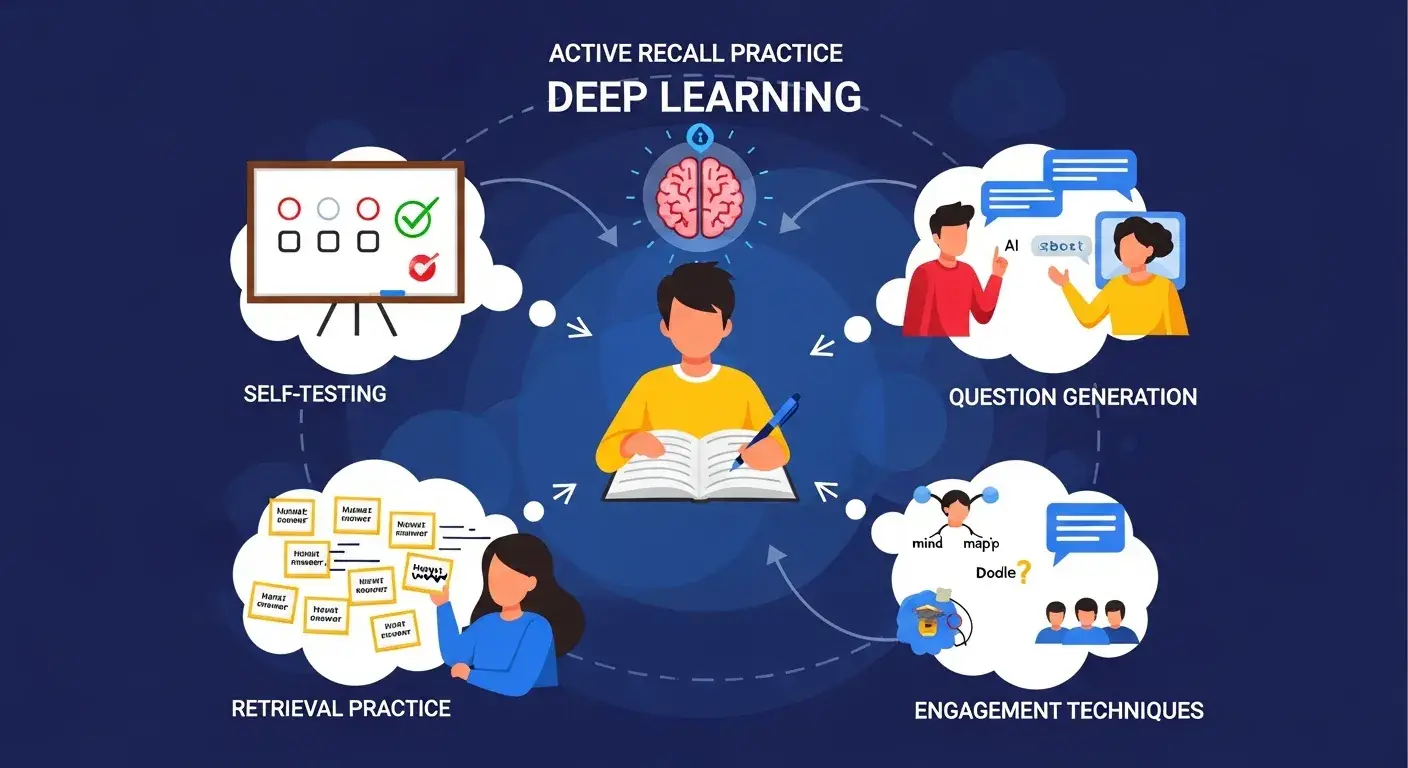
Mastering Active Recall: Proven Techniques for Better Memory Retention
Are you tired of studying for hours only to forget most of what you've learned days later? The secret to truly understanding and retaining information isn't just about how much you study, but how you study. This article will guide you through mastering active recall, a powerful learning strategy that transforms passive review into dynamic memory consolidation. By actively retrieving information from your mind, rather than passively rereading it, you forge stronger neural pathways, leading to significantly better memory retention and deeper comprehension.
Active recall is more than just a study hack; it's a fundamental shift in how you engage with knowledge. It challenges your brain to work harder, making the learning process more effective and efficient. Prepare to unlock your full learning potential and say goodbye to the frustration of forgotten facts.
Key Points for Mastering Active Recall
- Engage Your Brain: Active recall forces your brain to retrieve information, strengthening memory.
- Beyond Rereading: It's a superior alternative to passive study methods.
- Spaced Repetition: Combine active recall with spaced repetition for optimal long-term memory.
- Self-Testing is Key: Regularly test yourself without notes to identify knowledge gaps.
- Deeper Understanding: Leads to a more profound grasp of concepts, not just memorization.
What is Active Recall and Why is it Essential for Learning?
Active recall, also known as retrieval practice, is a learning method where you deliberately try to remember information from scratch, without looking at your notes or textbook. Instead of simply rereading material, you actively pull it from your memory. This process of effortful retrieval is what makes active recall so effective for better memory retention. It's like exercising a muscle; the more you challenge your brain to retrieve information, the stronger those memory connections become.
The essence of active recall lies in its departure from passive learning. When you passively reread, highlight, or listen, your brain often creates an illusion of knowing. You might recognize the information, but that doesn't mean you can recall it independently. Active recall shatters this illusion, forcing you to confront what you truly know and what you don't. This honest assessment is crucial for directing your study efforts where they're most needed, ensuring you're not wasting time on already mastered concepts.
Core Principles of Effective Active Recall Strategies
Implementing active recall effectively requires understanding its core principles and integrating them into your study routine. These strategies are designed to maximize the benefits of retrieval practice, leading to significant improvements in your learning outcomes.
Spaced Repetition Integration
One of the most powerful ways to enhance active recall is by combining it with spaced repetition. This technique involves reviewing information at increasing intervals over time. Instead of cramming, you revisit material just as you're about to forget it, reinforcing the memory. A 2024 review published in the Journal of Educational Psychology highlighted spaced repetition as a critical component for long-term knowledge retention, especially when paired with active retrieval. This strategic timing ensures that each recall attempt is challenging enough to strengthen memory without being overly frustrating.
Self-Testing and Questioning
The simplest yet most potent form of active recall is self-testing. After reading a section, close your book and try to explain the main ideas in your own words. Ask yourself questions like:
- "What were the three main points of this chapter?"
- "How does this concept relate to what I learned last week?"
- "Can I define this term without looking?" This deliberate questioning forces your brain to retrieve, rather than merely recognize. Don't be afraid to struggle; that struggle is precisely where the learning happens.
Flashcards and Digital Tools
Flashcards are classic active recall tools. On one side, write a question or a term; on the other, the answer or definition. The key is to always try to recall the answer before flipping the card. Digital flashcard apps like Anki or Quizlet take this a step further by incorporating spaced repetition algorithms, automatically scheduling reviews based on your performance. This personalized approach ensures you're focusing on the information you find most challenging, making your study time incredibly efficient.
Advanced Active Recall Techniques for Enhanced Learning
Beyond basic self-testing, several advanced techniques can further amplify the power of active recall, pushing your learning to new depths. These methods encourage deeper processing and more intricate connections within your knowledge network.
The Feynman Technique: Explaining to Learn
Named after Nobel laureate Richard Feynman, this technique involves explaining a concept in simple terms, as if teaching it to someone else (or even a rubber duck).
- Choose a concept: Select a topic you want to understand better.
- Explain it simply: Write down or verbalize your explanation in plain language.
- Identify gaps: When you get stuck, go back to your source material.
- Simplify and refine: Rework your explanation until it's clear and concise. This process forces active retrieval, identifies gaps in understanding, and simplifies complex ideas, making them easier to retain.
Retrieval Practice with Concept Mapping
Concept mapping is a visual tool that helps organize and represent knowledge. To integrate active recall, try creating a concept map from memory after studying a topic. Start with a central idea and branch out with related concepts, linking them with descriptive phrases. This not only tests your recall of individual facts but also your understanding of the relationships between them. Research from Stanford University in 2023 demonstrated that students who engaged in retrieval-based concept mapping showed significantly higher retention rates than those who simply reviewed pre-made maps.
Leveraging Technology: AI-Powered Learning Platforms
The latest industry trend in mastering active recall involves adaptive learning platforms powered by artificial intelligence. These platforms go beyond traditional spaced repetition by dynamically adjusting the difficulty and timing of recall questions based on a user's real-time performance, learning style, and even emotional state (through subtle cues). According to a 2025 report by the Learning Sciences Institute, these AI-driven systems are showing promising results in optimizing individual learning paths, making retrieval practice more personalized and effective than ever before. This represents a significant leap from static flashcard systems, offering truly differentiated value in modern learning.
Overcoming Common Challenges in Active Recall Practice
While incredibly effective, active recall can present its own set of challenges. Recognizing and addressing these hurdles is key to maintaining a consistent and productive practice.
Dealing with Frustration and Forgetting
It's natural to feel frustrated when you can't recall information, but this struggle is a sign that you're learning effectively. Embrace forgetting as a crucial part of the learning process. Each time you struggle and then successfully retrieve a piece of information, you strengthen that memory. Instead of seeing forgetting as a failure, view it as an opportunity for deeper learning. This shift in mindset, a unique insight often overlooked, is vital for building resilience in your study habits.
Time Management for Consistent Practice
Integrating active recall into a busy schedule requires discipline. Break down your study sessions into smaller, manageable chunks. Even 10-15 minutes of dedicated retrieval practice can be highly beneficial. Schedule specific times for self-testing, just as you would for lectures or assignments. Consistency, even in small doses, is far more effective than infrequent, lengthy cramming sessions. For those interested in optimizing their learning environment, explore our resources on creating a conducive study space.
The Science Behind Enhanced Memory Retention
The effectiveness of active recall is firmly rooted in cognitive psychology and neuroscience. When you engage in retrieval practice, your brain undergoes several crucial processes. It strengthens the neural pathways associated with the retrieved information, making it easier to access in the future. This is known as the testing effect or retrieval practice effect.
Furthermore, active recall helps to solidify the context around the information, creating more retrieval cues. This means you're not just memorizing isolated facts but building a robust network of interconnected knowledge. The effort involved in retrieval also signals to your brain that the information is important, prioritizing it for long-term storage. Understanding cognitive biases can further enhance your learning journey; look for our articles on cognitive psychology.
FAQ Section
What's the difference between active recall and passive review?
Active recall involves effortfully retrieving information from memory without external aids, like answering a question from scratch. Passive review, conversely, is about re-exposing yourself to information, such as rereading notes or highlighting text. While passive review can create familiarity, active recall builds stronger, more durable memories by forcing your brain to work harder to access the information.
How often should I practice active recall?
The