Mastering Memory: Advanced Techniques for Better Knowledge Retention
Mastering Memory: Advanced Techniques for Better Knowledge Retention
In today's information-saturated world, the ability to effectively retain and recall knowledge is not just an advantage, it's a necessity. Whether you're a student facing exams, a professional acquiring new skills, or simply someone who wants to keep their mind sharp, mastering memory techniques can significantly boost your learning and cognitive abilities. This guide delves into advanced techniques for better knowledge retention, moving beyond basic memorization to embrace sophisticated strategies that promote deep understanding and lasting recall. By implementing these methods, you can transform how you learn and remember, making knowledge acquisition a more efficient and rewarding process.
Key Points:
- Spaced Repetition Systems: Leverage algorithms to review information at optimal intervals.
- Active Recall & Self-Testing: Engage your brain by retrieving information without looking.
- Mnemonic Devices: Employ creative associations to encode complex information.
- The Feynman Technique: Explain concepts in simple terms to identify knowledge gaps.
- Mind Mapping: Visually organize information to understand relationships and hierarchies.
The Science Behind Effective Memory Retention
Understanding how our brains form and retrieve memories is the first step towards mastering them. Memory isn't a single entity; it involves encoding, storage, and retrieval. Encoding is the process of converting information into a form that can be stored in memory. Storage is the retention of this encoded information over time. Retrieval is the process of accessing stored information when needed. Advanced techniques for better knowledge retention work by optimizing each of these stages. They move away from passive learning, such as simply re-reading notes, towards active engagement with the material. This active engagement strengthens neural pathways, making memories more robust and accessible.
A key principle in memory science is the forgetting curve, first described by Hermann Ebbinghaus. This curve illustrates how we rapidly forget information if we don't actively reinforce it. Conversely, timely review can dramatically slow down forgetting. Modern memory techniques leverage this principle, often with sophisticated timing mechanisms.
Advanced Techniques for Enhanced Knowledge Retention
Moving beyond rote memorization, these advanced strategies focus on deeper processing and more effective recall mechanisms.
1. Spaced Repetition Systems (SRS)
Spaced Repetition Systems are a cornerstone of modern, effective learning. SRS software, like Anki or Quizlet's spaced repetition mode, uses algorithms to present information you're learning at increasing intervals. The idea is simple: if you're about to forget something, the system prompts you to review it. If you recall it easily, the interval before the next review is extended.
- How it works: You create flashcards (digital or physical) for facts, concepts, or vocabulary. When you review a card, you indicate how well you remembered it. The SRS then schedules your next review based on your response. This scientifically proven method ensures you spend more time on information you find difficult and less time on what you already know well, leading to efficient long-term memory consolidation.
- Differentiated Value: Unlike simple flashcards, SRS adapts to your individual learning pace, making it significantly more efficient than manual review schedules. It targets your forgetting curve precisely.
For more on this topic, readers can explore articles on optimizing study schedules.
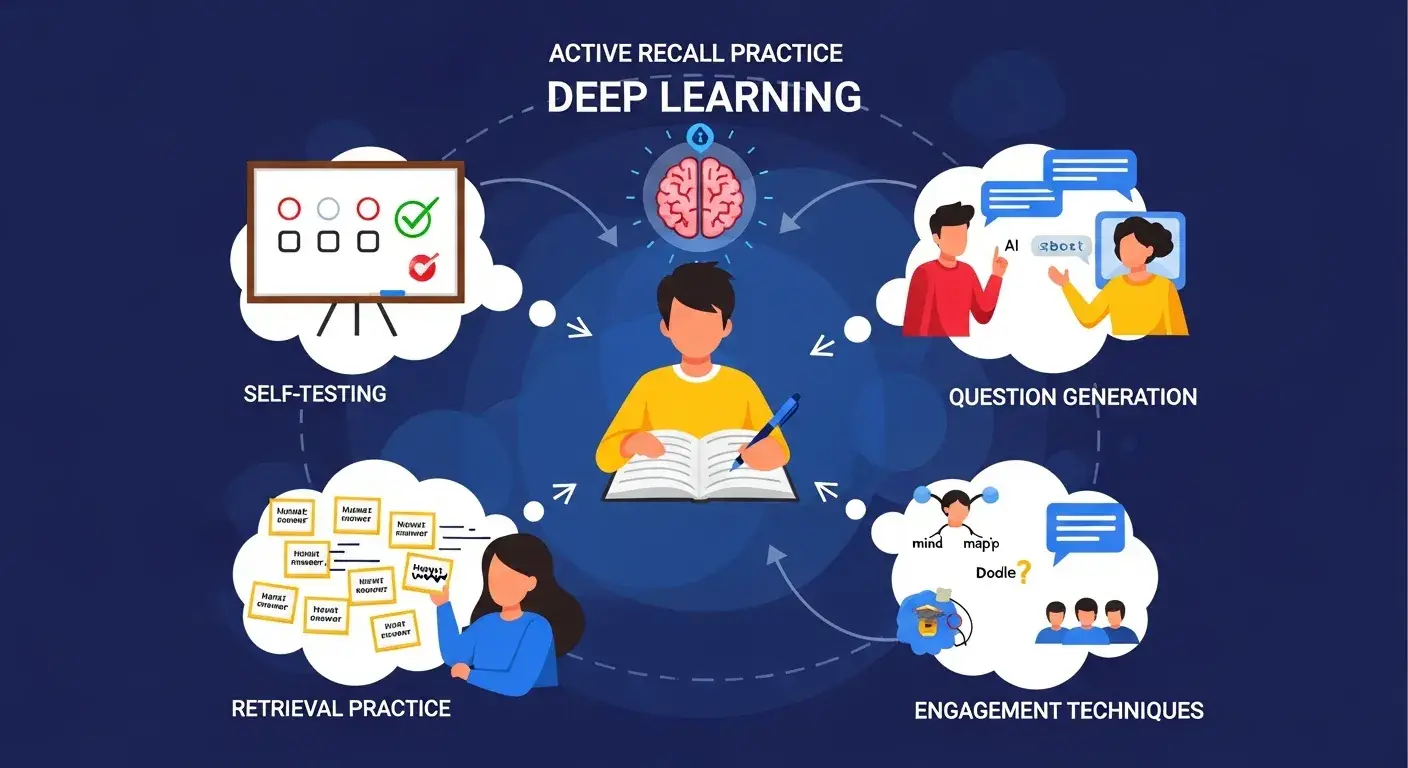
2. Active Recall and Self-Testing
This technique is about forcing your brain to retrieve information rather than passively recognizing it. Instead of re-reading your notes, try to recall the information from memory. This can be done through:
- Flashcards: Ask a question on one side and answer it from memory on the other.
- Practice Questions: Use end-of-chapter questions or create your own.
- Summarization: After reading a section, close the book and try to summarize the key points aloud or in writing.
- Blurting: Write down everything you can remember about a topic without looking at your notes. Then, check your notes for accuracy and completeness.
- Evidence: Studies have consistently shown that active recall significantly improves long-term retention compared to passive review methods like rereading. (Source: Dunlosky, J., et al. (2013). Improving Students' Learning With Effective Learning Techniques: Promising Directions From Educational, Psychological, and Neuroscience Research. Psychological Science in the Public Interest, 14(1), 4-58). This research highlights active recall as one of the most effective learning strategies.
3. Mnemonic Devices
Mnemonic devices are memory aids that help you encode and recall information by creating associations. They are particularly useful for remembering lists, sequences, or abstract concepts.
- Acronyms: Creating a word from the first letters of a list of items. For example, ROY G. BIV for the colors of the rainbow.
- Acrostics: Creating a sentence where the first letter of each word stands for an item you need to remember. For example, "My Very Educated Mother Just Served Us Noodles" for the planets.
- Method of Loci (Memory Palace): This ancient technique involves associating items you want to remember with specific locations in a familiar place (like your house). You mentally walk through the place, recalling the items at each location.
- Imagery and Association: Creating vivid, often unusual, mental images that link pieces of information together. The more bizarre or emotional the image, the more memorable it tends to be.
These methods transform abstract data into memorable anchors, making recall much easier.
4. The Feynman Technique
Named after physicist Richard Feynman, this technique is a powerful way to ensure deep understanding and identify knowledge gaps. It involves explaining a concept in simple terms as if you were teaching it to a child.
- Choose a concept: Select the topic you want to understand.
- Teach it to a child: Explain it in the simplest possible language, avoiding jargon.
- Identify gaps: When you struggle to explain something simply, or use complex terms, that's a sign of a knowledge gap. Go back to your source material to clarify.
- Simplify and refine: Once you've clarified, simplify your explanation further. Repeat until you can explain it clearly and concisely.
- Differentiated Value: This method goes beyond mere memorization by forcing you to truly grasp the underlying principles and connections, ensuring that your knowledge is not just superficial. It's an excellent tool for self-assessment.
5. Mind Mapping
Mind mapping is a visual brainstorming and note-taking technique that helps you organize information logically and see relationships between ideas. It starts with a central topic and branches out into subtopics, with each branch further subdividing.
- Key Features: Uses keywords, images, colors, and branch structures. This visual approach mimics how our brains naturally make connections.
- Benefits: Encourages creativity, enhances memory through visual cues, and provides a holistic overview of a subject. It’s excellent for planning, studying complex topics, and problem-solving.
For more on visual learning strategies, readers can explore resources on cognitive mapping.
Leveraging Latest Trends in Memory Science
The field of memory and learning is constantly evolving. Two emerging areas offer exciting possibilities for enhancing knowledge retention:
1. Personalized Learning Pathways
Recent advancements in AI and learning analytics allow for highly personalized learning experiences. Instead of a one-size-fits-all approach, platforms can now adapt content delivery, pacing, and review schedules based on an individual's unique learning style, progress, and even emotional state. This dynamic adaptation ensures that learning is always optimized for the individual, leading to more efficient and effective knowledge retention.
- Industry Insight: Companies are investing heavily in AI-driven adaptive learning platforms that analyze user interaction data to create bespoke learning journeys. (Source: Global EdTech Market Analysis 2024-2029, published by various market research firms, 2024). This trend emphasizes how technology is refining personalized memory strategies.
2. Neuroplasticity and Lifestyle Factors
There's a growing recognition of the profound link between lifestyle factors and our brain's ability to form and retain memories. This includes:
- Sleep Optimization: Quality sleep is crucial for memory consolidation. During sleep, the brain processes and stores information learned during the day.
- Mindfulness and Stress Management: Chronic stress negatively impacts memory. Mindfulness practices can reduce stress and improve focus, thereby enhancing learning.
- Nutrition: Certain nutrients, like omega-3 fatty acids and antioxidants, are vital for brain health and cognitive function.
- Exercise: Regular physical activity increases blood flow to the brain, promoting the growth of new neurons and improving memory.
Embracing a holistic approach that includes these lifestyle elements can significantly amplify the effectiveness of any memory technique.
Frequently Asked Questions (FAQ)
Q1: How quickly can I expect to see results from using these advanced memory techniques? A1: Results vary depending on the technique and your consistency. With dedicated practice, you may notice improved recall and understanding within a few weeks. Spaced repetition systems, for example, start showing cumulative benefits over time.
Q2: Are these techniques suitable for all types of information? A2: Yes, these techniques are highly versatile. While some, like mnemonics, are excellent for factual recall, others like the Feynman technique are ideal for understanding complex concepts, and mind mapping is great for organizing large amounts of information.
Q3: What is the best way to start implementing these strategies? A3: Begin with one or two techniques that resonate most with you. For instance, try incorporating active recall into your study routine or setting up a spaced repetition system for a specific subject you're learning. Consistency is key.
Conclusion: Your Journey to a Sharper Mind
Mastering memory is an ongoing journey, not a destination. By integrating advanced techniques for better knowledge retention into your daily learning habits, you are investing in your cognitive health and your ability to learn and adapt throughout life. Remember, the most effective learners are not those with innate talent, but those who employ smart strategies consistently. Embrace active recall, leverage the power of spaced repetition, get creative with mnemonics, and strive for deep understanding with the Feynman technique and mind mapping.
Don't just consume information; engage with it, question it, and make it your own. For readers interested in further developing their learning strategies, exploring articles on metacognition and lifelong learning can provide additional valuable insights.
We encourage you to share your favorite memory techniques in the comments below and subscribe for more insights into optimizing your learning and cognitive abilities!