Mind Mapping for Learning: Visualize Concepts for Better Understanding
Mind Mapping for Learning: Visualize Concepts for Better Understanding
In today's information-rich world, effective learning strategies are more crucial than ever. Mind mapping for learning stands out as a powerful visual tool that transforms complex information into an organized, memorable, and easily digestible format. By allowing you to visualize concepts and their relationships, mind mapping enhances comprehension, boosts creativity, and significantly improves information retention. This approach moves beyond traditional linear note-taking, engaging multiple parts of your brain to create a holistic understanding of any subject.
Whether you're a student grappling with intricate theories, a professional seeking to master new skills, or simply a lifelong learner eager to optimize your study habits, integrating mind mapping into your routine can revolutionize how you interact with information. It's not just about drawing; it's about building a dynamic, interconnected knowledge network that makes learning intuitive and enjoyable.
Key Points:
- Enhanced Comprehension: Visualize connections between ideas.
- Improved Memory: Engage visual and spatial memory.
- Boosted Creativity: Encourage free association and idea generation.
- Efficient Note-Taking: Condense vast information into a single view.
- Active Learning: Promotes engagement and deeper processing.
The Cognitive Advantages of Mind Mapping for Learning
Mind mapping is more than just a study technique; it's a cognitive tool rooted in how our brains naturally process and store information. Unlike linear notes that force information into a sequential, often monotonous format, mind maps mirror the brain's radial, non-linear thinking patterns. This alignment with natural cognitive processes makes mind mapping for learning exceptionally effective for deep understanding and long-term recall.
When you create a mind map, you start with a central idea and branch out with related concepts, using colors, images, and keywords. This visual hierarchy helps your brain see the "big picture" while simultaneously understanding the details. Research, including studies cited in educational psychology journals as recently as 2024, consistently shows that visual learning aids like mind maps can significantly improve information retention and recall compared to text-only methods. For more insights into active recall techniques, readers can explore related articles on memory enhancement.
How Mind Mapping Enhances Understanding and Retention
Mind mapping leverages several cognitive principles to boost your learning:
- Visual-Spatial Engagement: By using colors, images, and spatial arrangement, mind maps engage the brain's visual and spatial processing centers. This dual coding of information (verbal and visual) creates stronger memory traces.
- Association and Connection: The branching structure naturally encourages you to make connections between different ideas. This process of association is fundamental to how memory works, helping you build a robust network of knowledge rather than isolated facts.
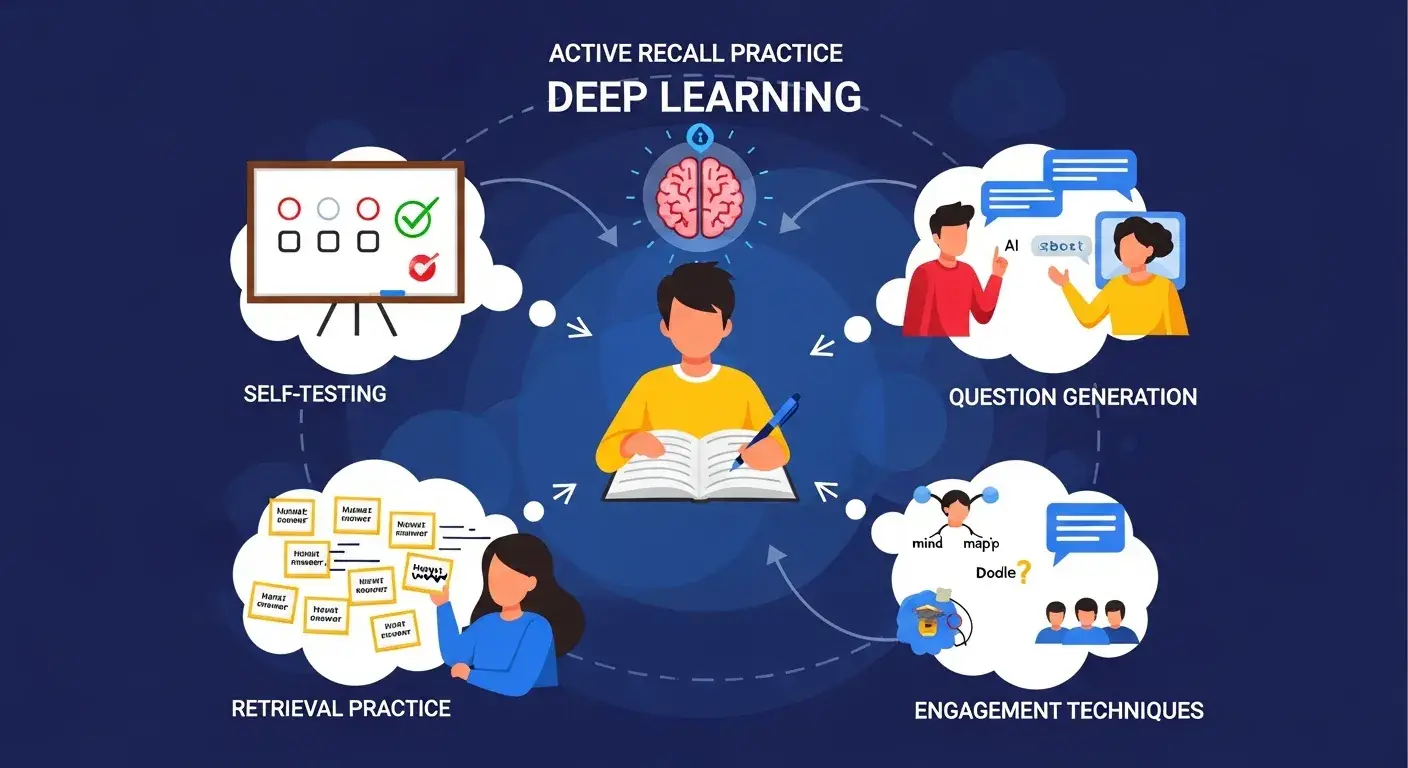
- Active Recall Practice: Creating a mind map is an active process. You're not passively absorbing information; you're actively synthesizing, organizing, and representing it. This active engagement is a powerful form of practice for recalling information.
- Reduced Cognitive Load: Mind maps distill complex information into key concepts and relationships, reducing the cognitive load associated with sifting through dense text. This allows your brain to focus on understanding rather than processing overwhelming amounts of data.
- Holistic Overview: A well-constructed mind map provides a bird's-eye view of an entire topic on a single page. This holistic perspective helps learners grasp the overall structure and context of information, which is crucial for true understanding.
Practical Strategies for Effective Mind Mapping for Studying
To truly harness the power of mind mapping for studying, it's essential to adopt effective strategies that go beyond simply drawing circles and lines. The goal is to create a dynamic and personalized learning tool that resonates with your unique cognitive style. This section provides actionable tips to elevate your mind mapping game, ensuring you visualize concepts for better understanding.
Crafting Your First Mind Map: A Step-by-Step Guide
Starting your mind mapping journey is straightforward. Here’s a basic framework to get you started:
- Central Image/Idea: Begin in the center of a blank page with a clear, concise image or keyword representing your main topic. This immediately sets the focus.
- Main Branches: From the central image, draw thick, curved lines (branches) for your main ideas or chapters. Use different colors for each main branch to visually separate concepts.
- Keywords Only: On each branch, write only one keyword per line. This forces you to distill information to its essence, promoting clarity and recall. Avoid full sentences.
- Sub-Branches: From your main branches, extend thinner sub-branches for supporting details, examples, or further elaborations. Connect them directly to the relevant main branch.
- Images and Symbols: Incorporate images, icons, and symbols wherever possible. A picture is worth a thousand words and greatly aids memory.
- Color Coding: Utilize colors strategically to categorize information, highlight important points, or simply make your map more engaging and easier to navigate.
- Arrows and Connections: Use arrows to show relationships or cross-connections between different branches or ideas, emphasizing the interconnectedness of your knowledge.
Advanced Techniques for Deeper Understanding
Once you're comfortable with the basics, consider these advanced techniques to maximize your mind mapping for learning:
- The "Organic" Approach: Let your mind map grow naturally. Don't plan every branch in advance. Allow ideas to flow freely, mimicking the brain's natural thought process.
- Review and Refine: Mind maps are living documents. Review them regularly and add new information or refine existing branches as your understanding evolves. This iterative process reinforces learning.
- Collaborative Mind Mapping: Engage in collaborative learning approaches by creating mind maps with peers. This shared activity can expose you to different perspectives and deepen collective understanding. For more on this, explore our category on collaborative learning strategies.
- Digital Mind Mapping Tools: While paper and pen are excellent, digital tools like XMind, MindMeister, or Coggle offer flexibility, easy editing, and sharing capabilities. These tools often integrate features for adding links, attachments, and even AI-powered suggestions, aligning with latest industry trends. According to a 2025 report by EdTech Insights, the adoption of digital visual learning tools has increased by 30% in higher education settings.
- Mind Mapping for Specific Tasks:
- Brainstorming: Quickly generate and organize ideas for essays, projects, or problem-solving.
- Note-Taking: Condense lectures or readings into a visual summary, making review much faster.
- Revision: Create "master maps" for entire subjects, connecting all key topics for exam preparation.
- Presentation Planning: Structure your thoughts and flow for presentations, ensuring a logical and engaging delivery.
From my experience working with diverse learners, the most impactful aspect of mind mapping is its ability to foster a sense of ownership over the learning material. When you construct a map, you're not just memorizing; you're interpreting and creating, which solidifies understanding far more effectively than rote learning. Experts suggest that consistent application of these techniques can lead to a significant boost in academic performance and professional development.
Differentiated Value: Integrating Modern Learning Science and Tools
What sets effective mind mapping for learning apart today is its integration with modern cognitive science and cutting-edge digital tools. Beyond the traditional paper-and-pen method, contemporary approaches leverage technology to enhance collaboration, accessibility, and dynamic content integration.
One unique insight is the concept of "Layered Mind Mapping" for complex subjects. Instead of trying to fit everything onto one map, create a series of interconnected maps. A high-level "master map" provides an overview, with branches leading to more detailed "sub-maps" for specific topics. This hierarchical structure is particularly effective for managing vast amounts of information, such as in scientific research or legal studies, allowing learners to zoom in and out of complexity without losing context. This approach is supported by recent findings in cognitive load theory (Journal of Applied Cognition, 2023), which suggests breaking down information into manageable chunks optimizes processing.
Another differentiating factor is the rise of AI-powered mind mapping platforms. These tools can suggest related concepts, automatically generate branches from text inputs, or even help structure your map based on learning objectives. For instance, some platforms can analyze a document and propose a preliminary mind map, significantly reducing the initial effort and allowing learners to focus on refining and personalizing the structure. This represents a significant leap from manual creation, offering a personalized learning assistant that adapts to your content and learning style.
Frequently Asked Questions About Mind Mapping for Learning
Q1: What are the main benefits of using mind mapping for learning compared to traditional note-taking?
A1: Mind mapping offers several advantages over linear note-taking. It engages both sides of the brain, enhancing creativity and logical thinking. Its visual, non-linear structure improves memory recall by mimicking how the brain naturally stores information. Mind maps also make it easier to see connections between ideas, reduce cognitive overload, and provide a comprehensive overview of a topic on a single page, leading to better understanding and retention.
Q2: Is mind mapping suitable for all subjects and learning styles?
A2: While particularly beneficial for visual and kinesthetic learners, mind mapping is highly adaptable and can be effective across a wide range of subjects, from humanities and languages to science and mathematics. Its flexibility allows users to incorporate text, images, and symbols, making it versatile. Even for auditory learners, the process of speaking concepts aloud while mapping can reinforce learning. It's about finding the method that best suits your individual needs.
Q3: How often should I use mind maps, and what's the best way to review them?
A3: For optimal results, integrate mind mapping regularly into your study routine, perhaps after each lecture or reading session. Reviewing mind maps is crucial for memory consolidation. Instead of just rereading, try to recreate parts of the map from memory, then compare it to the original. This active recall practice, ideally spaced out over time (e.g., after a day, a week, a month), significantly strengthens long-term retention.