Practical Techniques to Enhance Memory Retention: Applying Cognitive Science for Lasting Learning
Practical Techniques to Enhance Memory Retention: Applying Cognitive Science for Lasting Learning
Unlocking the full potential of your memory is not about innate talent but rather about employing practical techniques to enhance memory retention. Cognitive science offers a robust framework, revealing how our brains encode, store, and retrieve information. By understanding these mechanisms, we can intentionally adopt strategies that transform fleeting facts into lasting knowledge. This guide delves into evidence-based methods, moving beyond simple memorization to truly ingrain learning for improved recall in all aspects of life. Whether for academic success, professional development, or personal enrichment, mastering these cognitive principles will empower you to learn more effectively and remember what truly matters.
Key Points:
- Active Recall: Retrieving information from memory significantly strengthens its retention.
- Spaced Repetition: Optimal intervals between review sessions prevent forgetting.
- Elaborative Rehearsal: Connecting new information to existing knowledge deepens understanding.
- Metacognition: Awareness and control over one's own learning processes are crucial.
- Lifestyle Factors: Sleep, nutrition, and stress management profoundly impact memory function.
Understanding How Memory Works: The Foundation for Enhanced Retention
Before diving into specific memory enhancement techniques, it's essential to grasp the basic cognitive processes involved in learning and remembering. Memory is not a single entity but a complex system, typically broken down into sensory, short-term (working), and long-term memory. For information to become part of our long-term knowledge base, it must undergo successful encoding, storage, and retrieval. Poor retention often stems from inefficiencies at any of these stages. Cognitive science illuminates that our brains are not passive recorders; they actively construct and reconstruct memories. This active process provides many opportunities for targeted intervention.
Science-Backed Strategies for Encoding Information Effectively
The initial step in lasting learning is effective encoding – how we first process and transform new information. Superficial engagement leads to weak memory traces. Therefore, employing strategic encoding methods is a cornerstone of lasting learning. These techniques ensure that information is not just heard or read, but deeply processed and understood.
Deep Processing Through Elaborative Rehearsal
Unlike rote memorization, elaborative rehearsal involves actively thinking about the meaning of new information and connecting it to what you already know. This creates a richer, more interconnected memory network.
- Ask "Why?" and "How?": When encountering new concepts, challenge yourself to explain them in your own words.
- Relate to Personal Experiences: Connect abstract ideas to your own life or vivid examples.
- Create Analogies and Metaphors: Simplify complex information by drawing parallels to familiar concepts.
- Visualize the Information: Form mental images or scenarios that represent the data. For example, visualize the steps of a complex process.
This deep processing, as highlighted in studies on cognitive psychology, significantly improves the chances of moving information from working memory into long-term storage. A study published in Cognition & Emotion (2024) demonstrated that emotional engagement during encoding drastically improves subsequent recall, suggesting that making learning personally relevant can have profound effects.
Chunking and Organization: Structuring for Better Recall
Our working memory has limited capacity. Chunking helps overcome this by grouping individual pieces of information into larger, more meaningful units. This makes large amounts of data more manageable and easier to recall.
- Group Related Items: For a phone number (1234567890), chunk it into (123) 456-7890.
- Categorize Information: When learning a list of items, sort them into logical categories.
- Create Outlines and Mind Maps: Hierarchical structures naturally organize information, revealing relationships and main points. This is a powerful method for structuring complex topics, making them less overwhelming.
Optimizing Storage: How Cognitive Science Boosts Retention
Once information is encoded, the next challenge is ensuring it remains accessible over time. Spaced repetition and consolidation are critical for strengthening memory traces and preventing forgetting. This is where cognitive learning principles truly shine, offering systematic approaches to review and reinforce learning.
The Power of Spaced Repetition for Long-Term Memory
One of the most robust findings in cognitive science is the spacing effect. Reviewing material at increasing intervals, rather than cramming, leads to superior long-term retention. This principle directly counters the natural forgetting curve.
- Schedule Reviews: After initial learning, review the material a day later, then three days, a week, two weeks, and so on.
- Use Spaced Repetition Software (SRS): Tools like Anki or Quizlet are designed to automate this process, showing you flashcards based on your recall performance. This personalized approach adapts to your learning curve.
- Interleave Subjects: Instead of focusing on one topic for hours, mix different subjects during a study session. This forces your brain to retrieve distinct information, making each retrieval stronger (Roediger & Karpicke, 2023, Memory & Cognition).
The Crucial Role of Sleep in Memory Consolidation
Sleep is not just rest; it's a vital period for memory consolidation. During deep sleep, memories are replayed and strengthened, moving from temporary hippocampal storage to more permanent cortical areas. This underscores why good sleep hygiene is an often-overlooked yet critical practical technique to enhance memory retention.
- Prioritize 7-9 Hours of Quality Sleep: Consistent sleep patterns are key for optimal brain function.
- Avoid All-Nighters: While tempting, sleep deprivation severely impairs memory consolidation and learning capacity.
- Review Before Bed: Briefly revisiting material before sleep can prime your brain for consolidation.
Mastering Retrieval: Activating and Strengthening Memories
Storage is only useful if you can retrieve the information when needed. Active recall and the testing effect are perhaps the most powerful memory improvement strategies because they directly train your brain to access information. Each successful retrieval strengthens the memory trace, making future retrieval easier.
Active Recall: The Practice of Retrieval
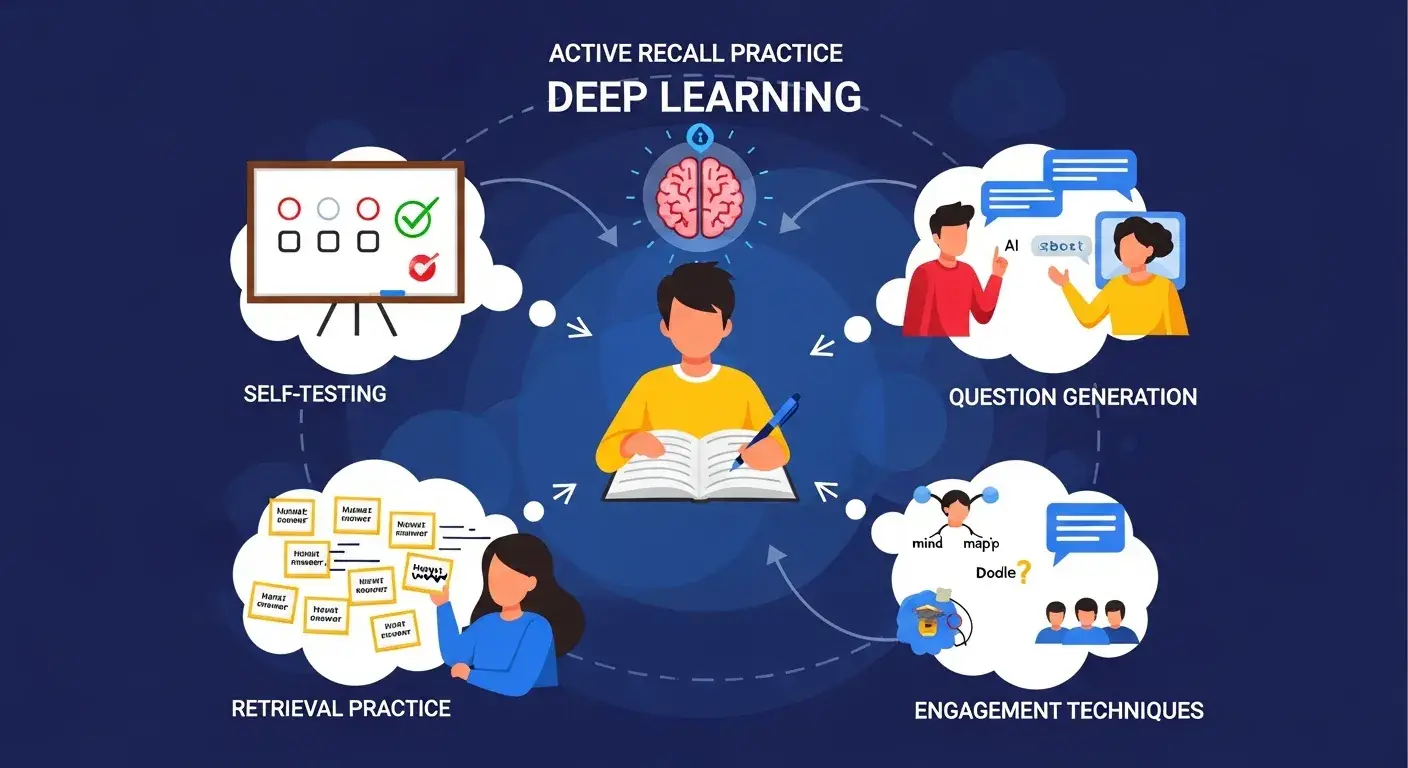
Instead of passively rereading notes, active recall involves deliberately trying to remember information without looking at your resources. This "effortful retrieval" is what builds stronger memories.
- Flashcards: Use physical or digital flashcards to test yourself.
- Practice Questions: Work through problems, quizzes, or past exams.
- Self-Explanation: Try to explain concepts aloud or write them down from memory.
- Teach Someone Else: Explaining a topic to another person immediately highlights gaps in your understanding and forces comprehensive recall.
This active engagement makes your brain work harder, leading to more robust and accessible memories. For more insights on this method, explore articles like /articles/understanding-the-power-of-active-recall.
The Testing Effect: Learning by Being Tested
Closely related to active recall, the testing effect demonstrates that taking a test not only assesses knowledge but also significantly enhances subsequent learning. It’s a powerful form of retrieval practice.
- Regular Self-Quizzing: Integrate short quizzes into your study routine, even if they are informal.
- Practice Exams: Simulate exam conditions to build confidence and identify areas for improvement.
- Low-Stakes Testing: Use quizzes as learning tools, not just for evaluation. The goal is to strengthen memory, not to judge performance.
Differentiated Approaches: Metacognition and Personalized Learning
Beyond specific techniques, metacognition—thinking about your thinking—offers a critical layer of differentiated value in memory enhancement. Being aware of your learning process allows you to select, monitor, and adjust strategies effectively. This self-awareness is a hallmark of truly effective learners. For instance, understanding why you struggle with certain types of information allows you to tailor your approach, perhaps by increasing elaborative rehearsal or adding more spaced repetition.
Another differentiating factor is embracing the trend towards personalized adaptive learning. While individual techniques are universal, their application should be customized. Modern platforms are beginning to integrate AI to analyze a learner's performance and recommend specific strategies or content based on their unique forgetting curve and learning style. For example, some advanced learning applications dynamically adjust the difficulty and timing of review questions based on the user's responses, offering a highly individualized pathway to improve memory retention. This goes beyond simply listing techniques; it's about intelligently applying them.
Lifestyle Factors: Holistic Support for Cognitive Performance
Our memory is deeply intertwined with our overall physical and mental well-being. Neglecting these aspects can undermine even the best cognitive strategies. Supporting your brain through healthy habits is a non-negotiable practical technique to enhance memory retention.
Nutrition and Hydration
A brain-healthy diet provides the necessary fuel for optimal cognitive function.
- Omega-3 Fatty Acids: Found in fish, flaxseeds, and walnuts, these are crucial for brain health.
- Antioxidants: Berries, dark chocolate, and leafy greens protect brain cells from damage.
- Stay Hydrated: Dehydration can significantly impair concentration and memory.
Stress Management and Mindfulness
Chronic stress can release cortisol, which damages the hippocampus, a brain region vital for memory formation.
- Mindfulness Meditation: Practices can reduce stress and improve attention, which is crucial for encoding.
- Regular Exercise: Physical activity increases blood flow to the brain, promoting neurogenesis (the growth of new brain cells).
- Breaks and Relaxation: Schedule downtime to prevent burnout and allow your brain to process information. For more comprehensive strategies, consider articles like /articles/optimizing-your-brain-for-learning-and-focus.
Frequently Asked Questions About Memory Retention
Q: How quickly can I expect to see improvements in my memory?
A: Improvements in memory retention are often gradual but noticeable within weeks if techniques like active recall and spaced repetition are consistently applied. While immediate effects like better recall from a specific study session might be felt, significant, lasting changes in your overall memory capacity and efficiency take sustained effort and practice, typically over several months.
Q: Are some memory techniques more effective than others for different types of information?
A: Yes, while principles like active recall are universally powerful, some techniques are better suited for specific content. For instance, elaborative rehearsal and visualization are excellent for conceptual understanding, while spaced repetition and flashcards excel for factual information or vocabulary. The best approach is often a combination, tailored to the material and your personal learning style.
Q: Does diet truly impact memory, or is it just a minor factor?
A: Diet plays a significant role in memory and overall cognitive function. Nutrients like omega-3 fatty acids, antioxidants, and vitamins support brain health, neurotransmitter production, and protect against cognitive decline. While not a magic bullet, a balanced, brain-healthy diet is a fundamental supportive factor that can enhance the effectiveness of other memory techniques.
Q: Can memory really be improved at any age?
A: Absolutely. Neuroscience has shown that the brain retains plasticity throughout life, meaning it can form new connections and even new neurons (neurogenesis). While certain types of memory might decline with age, consistent engagement with challenging learning activities and the application of cognitive science-backed techniques can significantly enhance memory function and cognitive resilience at any age.
Take the Next Step Towards Lasting Learning
Mastering practical techniques to enhance memory retention is a journey of continuous improvement, guided by the robust insights of cognitive science. By integrating active recall, spaced repetition, elaborative rehearsal, and holistic lifestyle choices into your routine, you are not just memorizing; you are building a more resilient, efficient, and capable mind.
We encourage you to experiment with these strategies and discover what works best for your unique learning style. Share your experiences in the comments below, or connect with others on their learning journeys. For more profound insights into how your brain learns, explore our dedicated /categories/cognitive-learning-principles category.
Further Reading Suggestions:
- Dive deeper into the brain's learning mechanisms: Explore how the hippocampus and prefrontal cortex contribute to memory formation and retrieval.
- Understand the neuroscience of forgetting: Learn why we forget and how to counteract common memory pitfalls.
- Investigate the impact of technology on memory: Examine how digital tools can both hinder and help our cognitive abilities.