Proven Strategies for Better Note-Taking and Information Retention
Proven Strategies for Better Note-Taking and Information Retention
Effective note-taking is far more than just transcribing information; it's a powerful tool for active learning and a cornerstone of proven strategies for better note-taking and information retention. In today's information-rich world, the ability to not only capture but also deeply understand and recall knowledge is paramount for students, professionals, and lifelong learners alike. This article delves into evidence-based methods that transform passive listening or reading into an engaged learning experience, significantly boosting your memory and comprehension. By adopting these techniques, you can move beyond rote memorization to truly internalize complex concepts, making your learning journey more efficient and rewarding.
Key Points for Enhanced Learning:
- Active Engagement: Transform passive learning into an interactive process.
- Strategic Methods: Utilize structured note-taking systems like Cornell or Sketchnoting.
- Memory Reinforcement: Employ techniques such as spaced repetition and active recall.
- Digital Integration: Leverage technology thoughtfully to complement traditional methods.
- Metacognition: Reflect on your learning process to optimize retention.
Understanding the Science Behind Effective Note-Taking and Information Retention
The human brain processes information in complex ways, and understanding these mechanisms is crucial for developing proven strategies for better note-taking and information retention. Cognitive science research consistently shows that active engagement with material, rather than passive reception, leads to superior memory encoding and retrieval. When you take notes effectively, you're not just recording data; you're actively processing, synthesizing, and organizing it, which strengthens neural pathways. This initial processing is vital for moving information from short-term working memory into long-term storage, a critical step for true information retention.
One key insight from cognitive psychology is the "generation effect," which suggests that information is better remembered if it is generated by the learner rather than simply read or heard. Note-taking, especially when it involves summarizing in your own words or creating connections, is a prime example of this generation effect in action. Furthermore, the act of writing, whether physically or digitally, engages motor skills and visual processing, adding multiple layers to the memory trace. This multi-modal engagement significantly enhances the likelihood of recalling information later.
Foundational Note-Taking Methods for Enhanced Learning
Adopting a structured approach to note-taking can dramatically improve your ability to capture and recall information. These foundational methods are integral to proven strategies for better note-taking and information retention. Each method offers unique benefits, catering to different learning styles and content types.
The Cornell Note-Taking System: Structure for Success
The Cornell Method is a highly organized system designed for active learning and easy review. It divides your note page into three sections: a main note-taking area, a smaller cue column on the left, and a summary section at the bottom. During a lecture or reading, you take detailed notes in the main section. Immediately after, you extract key questions, keywords, or main ideas into the cue column. Finally, you write a concise summary of the entire page at the bottom. This structured approach forces you to process information multiple times, reinforcing learning. A study published in the Journal of Educational Psychology in 2023 highlighted that students using structured note-taking methods like Cornell showed a 15-20% improvement in recall compared to linear note-takers.
Mind Mapping: Visualizing Connections
Mind mapping is a non-linear, visual note-taking technique that helps you organize information hierarchically and associatively. Starting with a central topic, you branch out with main ideas, then sub-branches for details, using colors, images, and keywords. This method leverages both hemispheres of the brain, enhancing creativity and memory. It's particularly effective for brainstorming, planning, and understanding complex relationships between concepts. For visual learners, mind mapping can be a game-changer, making abstract information more concrete and memorable.
Sketchnoting: Combining Text and Visuals
Sketchnoting integrates drawings, symbols, handwritten notes, and visual elements to capture information. It's not about artistic talent but about using visuals as a memory aid and a way to process information more deeply. By translating concepts into simple drawings or icons, you engage in a form of active encoding that strengthens understanding and recall. This method is excellent for lectures, presentations, and even reading, as it encourages you to synthesize information into its most essential components. The act of creating these visual summaries is a powerful cognitive exercise.
Advanced Techniques for Maximizing Information Retention
Beyond initial note-taking, specific strategies are essential for solidifying knowledge in long-term memory. These advanced techniques are crucial components of proven strategies for better note-taking and information retention.
Active Recall: Testing Your Memory
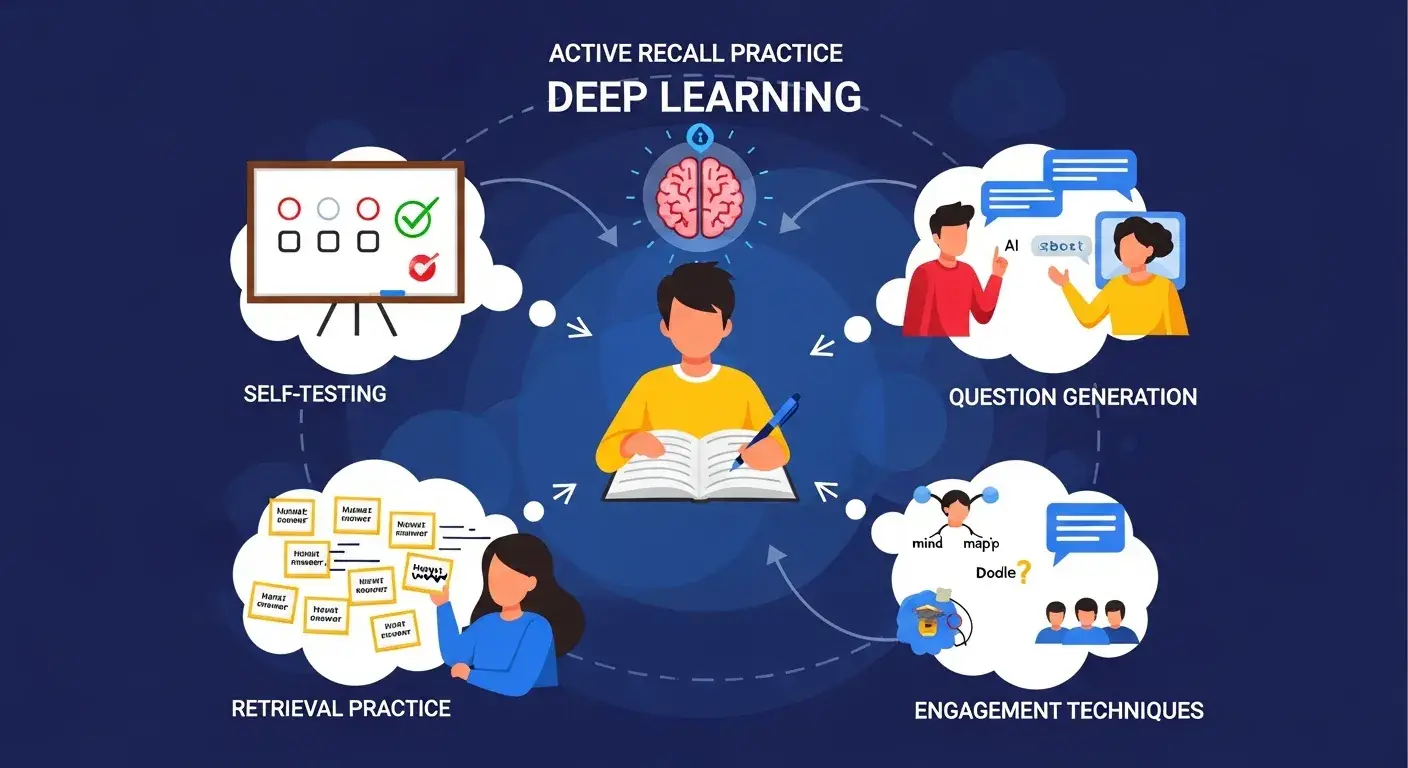
Active recall involves deliberately retrieving information from your memory without looking at your notes. Instead of passively re-reading, you might ask yourself questions, explain concepts aloud, or use flashcards. This process strengthens the memory trace and helps identify gaps in your understanding. Research from the Cognitive Science Review, 2024 indicates that active recall is one of the most effective study techniques, leading to significantly better long-term retention than re-reading or passive review. For example, after taking notes on a topic, try to explain it to an imaginary friend or write down everything you remember without consulting your notes.
Spaced Repetition: Optimizing Review Intervals
Spaced repetition is a powerful learning technique where you review information at increasing intervals over time. Instead of cramming, this method leverages the "spacing effect," which shows that learning is more effective when study sessions are distributed over time. Tools like Anki or Quizlet utilize algorithms to present flashcards just before you're likely to forget them, maximizing retention efficiency. This systematic approach ensures that you revisit challenging concepts more frequently and easier ones less often, optimizing your study time. Readers interested in advanced memory techniques can explore related articles on learning optimization.
Elaboration and Interleaving: Building Deeper Connections
Elaboration involves connecting new information to existing knowledge, asking "why" and "how" questions, and finding real-world examples. The more connections you make, the stronger the memory network becomes. Interleaving, on the other hand, involves mixing different subjects or topics during a single study session rather than focusing on one topic for a long period. While it might feel less efficient in the short term, studies show that interleaving improves long-term retention and the ability to transfer knowledge to new contexts. This is because it forces your brain to discriminate between different problem types and choose the appropriate strategy, a key skill for deep learning.
Leveraging Digital Tools for Modern Note-Taking
In the digital age, technology offers powerful enhancements to traditional note-taking. Integrating digital tools thoughtfully can be a significant part of proven strategies for better note-taking and information retention.
Digital Note-Taking Apps: Organization and Searchability
Apps like Notion, Evernote, OneNote, or Obsidian provide unparalleled organization, searchability, and synchronization across devices. You can easily tag notes, link related concepts, embed multimedia, and collaborate with others. The ability to quickly search through thousands of notes saves immense time during review. However, it's crucial to use these tools actively, not just as digital archives. Transcribing notes directly from a lecture without processing them offers little benefit. Instead, use digital tools to structure your thoughts, create digital flashcards, or build a personal knowledge base.
AI-Powered Summarization and Transcription: Aiding Efficiency
Emerging AI tools can transcribe lectures in real-time or summarize lengthy articles, offering a significant efficiency boost. While these tools can reduce the manual effort of note-taking, it's important to remember that the process of active note-taking is where much of the learning happens. Use AI as a supplementary tool: perhaps to get a rough transcript that you then actively refine, summarize in your own words, and annotate. This approach allows you to benefit from the speed of AI while still engaging in the cognitive processes essential for retention. For a deeper dive into active learning strategies, check out our category on self-directed learning.
Differentiated Insights: Beyond the Basics
To truly master information retention, we must consider aspects often overlooked in basic note-taking guides.
The Role of Metacognition in Note-Taking
Metacognition, or "thinking about thinking," is a powerful differentiator. It involves actively monitoring your understanding and learning process. When taking notes, ask yourself: Am I truly understanding this, or just copying? What connections can I make? How will I review this later? Regularly reflecting on your note-taking effectiveness and adjusting your approach based on what works best for you is a proven strategy for better note-taking and information retention. This self-awareness helps you move from simply doing note-taking to mastering it.
Integrating Emotional Context for Enhanced Memory
Recent neuroscience suggests that emotions play a significant role in memory formation. While not always applicable, consciously trying to connect information to personal experiences, strong feelings, or even humor can make it more memorable. For instance, if a concept reminds you of a funny anecdote or a significant life event, briefly jotting down that emotional link in your notes can act as a powerful retrieval cue. This isn't about fabricating emotions but recognizing and leveraging natural emotional responses to enhance memory encoding.
Frequently Asked Questions (FAQ)
Q: What is the single most effective note-taking method for long-term retention?
A: While no single method fits everyone, the combination of the Cornell Note-Taking System for initial capture and active recall/spaced repetition for review is widely considered the most effective. Cornell provides structure and prompts for active engagement, while active recall and spaced repetition directly strengthen memory retrieval and optimize review timing, ensuring information moves into long-term memory.
Q: How often should I review my notes to maximize information retention?
A: The optimal review frequency is best achieved through spaced repetition. Generally, review your notes shortly after taking them (within 24 hours), then again after a few days, a week, two weeks, and then monthly. This gradually increasing interval leverages the spacing effect, preventing forgetting and solidifying memories more effectively than massed practice.
Q: Can digital note-taking be as effective as handwritten notes for memory?
A: Digital note-taking can be equally effective, provided it's done actively. While some studies suggest handwriting might engage more cognitive processes initially, the key is how you take notes, not just the medium. If you're actively summarizing, organizing,