Spaced Repetition Technique: Unlock Long-Term Learning Success
Spaced Repetition Technique: Unlock Long-Term Learning Success
In today's information-saturated world, the ability to learn and retain new knowledge effectively is a superpower. We all encounter situations where we need to absorb complex information, from academic studies and professional development to mastering a new hobby. Traditional memorization methods often fall short, leading to frustration and a feeling of wasted effort. This is where the spaced repetition technique emerges as a scientifically-backed, highly effective strategy to move information from short-term recall to long-term memory. By strategically revisiting learned material at increasing intervals, you can dramatically improve your retention rates and unlock genuine, lasting understanding.
This powerful learning method leverages how our brains naturally forget and helps us combat that forgetting curve. Instead of cramming, which leads to rapid forgetting, spaced repetition optimizes review sessions to reinforce memory just before it fades. This makes learning more efficient, enjoyable, and ultimately, far more successful for long-term knowledge acquisition.
Key Points:
- Combats the Forgetting Curve: Revisit information at optimal intervals to prevent forgetting.
- Maximizes Learning Efficiency: Focuses review on what you're about to forget.
- Builds Robust Long-Term Memory: Moves knowledge from short-term to permanent storage.
- Adaptable and Versatile: Applicable to various subjects and learning styles.
- Reduces Study Time: More effective than cramming, saving you time in the long run.
Understanding the Science Behind Spaced Repetition
The core principle of the spaced repetition technique is rooted in the concept of the forgetting curve, first observed by Hermann Ebbinghaus in the late 19th century. Ebbinghaus discovered that we tend to forget information rapidly after initially learning it. Without any reinforcement, a significant portion of what we learn can be lost within hours or days. Spaced repetition directly counteracts this natural tendency.
The strategy involves reviewing information at specific, progressively longer intervals. The idea is to re-expose yourself to the material at the peak of your forgetting curve. At this point, your brain is primed to encode the information more deeply into long-term memory. Each successful recall strengthens the memory trace, making it more resistant to future forgetting.
This approach aligns with established principles of memory consolidation, a biological process where fragile new memories are transformed into stable, enduring ones. Studies have consistently shown that spaced retrieval practice, a key component of spaced repetition, is significantly more effective for long-term retention than massed practice (cramming) or simple re-reading. For instance, research published in Memory in 2024 highlighted that even brief spaced review sessions could enhance the long-term retention of complex procedural skills by up to 30% compared to traditional study methods.
How the Spaced Repetition Technique Works in Practice
Implementing spaced repetition doesn't require a complex scientific understanding; it's a practical, systematic approach. At its heart, it involves a cycle of learning, testing, and reviewing.
- Initial Learning: First, you learn new information. This could be reading a chapter, watching a lecture, or practicing a skill.
- First Review: A short time later (e.g., within 24 hours), you review the material. This might involve actively recalling key concepts or answering practice questions. If you recall it easily, you can wait a bit longer for the next review. If you struggle, you might need to review it again sooner.
- Subsequent Reviews: The intervals between reviews gradually increase. For material you find easy to remember, the intervals might expand from days to weeks, then months, and eventually years. For more challenging material, the intervals will remain shorter.
The beauty of this method is its adaptability. It can be applied manually using flashcards or digitally with specialized software.
Manual Application: The Flashcard Method
This is the most traditional and widely understood application of spaced repetition.
- Create Flashcards: For each piece of information you want to learn, create a flashcard. One side should have a question or prompt, and the other should have the answer or explanation.
- Initial Study: Go through your flashcards. When you can correctly answer a card, place it in a pile for future review. If you get it wrong, put it back in the "to be reviewed soon" pile.
- Systematic Review: Establish a review schedule. For example, review your "easy" pile daily, your "medium" pile every three days, and your "difficult" pile daily until mastered. As you consistently answer cards correctly, you move them to piles with longer review intervals.
Digital Spaced Repetition Systems (SRS)
Modern technology has made implementing spaced repetition even more efficient through Spaced Repetition Systems (SRS) software. These applications automate the scheduling and interval management, allowing you to focus solely on learning.
- How they Work: You input the information you want to learn (e.g., vocabulary, historical dates, scientific concepts) into the software. The SRS then presents you with questions or prompts at calculated intervals based on your performance.
- Performance Tracking: When you encounter a flashcard or question, you typically rate your recall accuracy (e.g., "Easy," "Good," "Hard," "Again"). The algorithm uses this feedback to determine when to show you the item next.
- Popular Examples: Software like Anki, Quizlet (with its "Learn" mode), and Memrise are widely used SRS tools.
Differentiated Value: The Power of Active Recall and Gamification
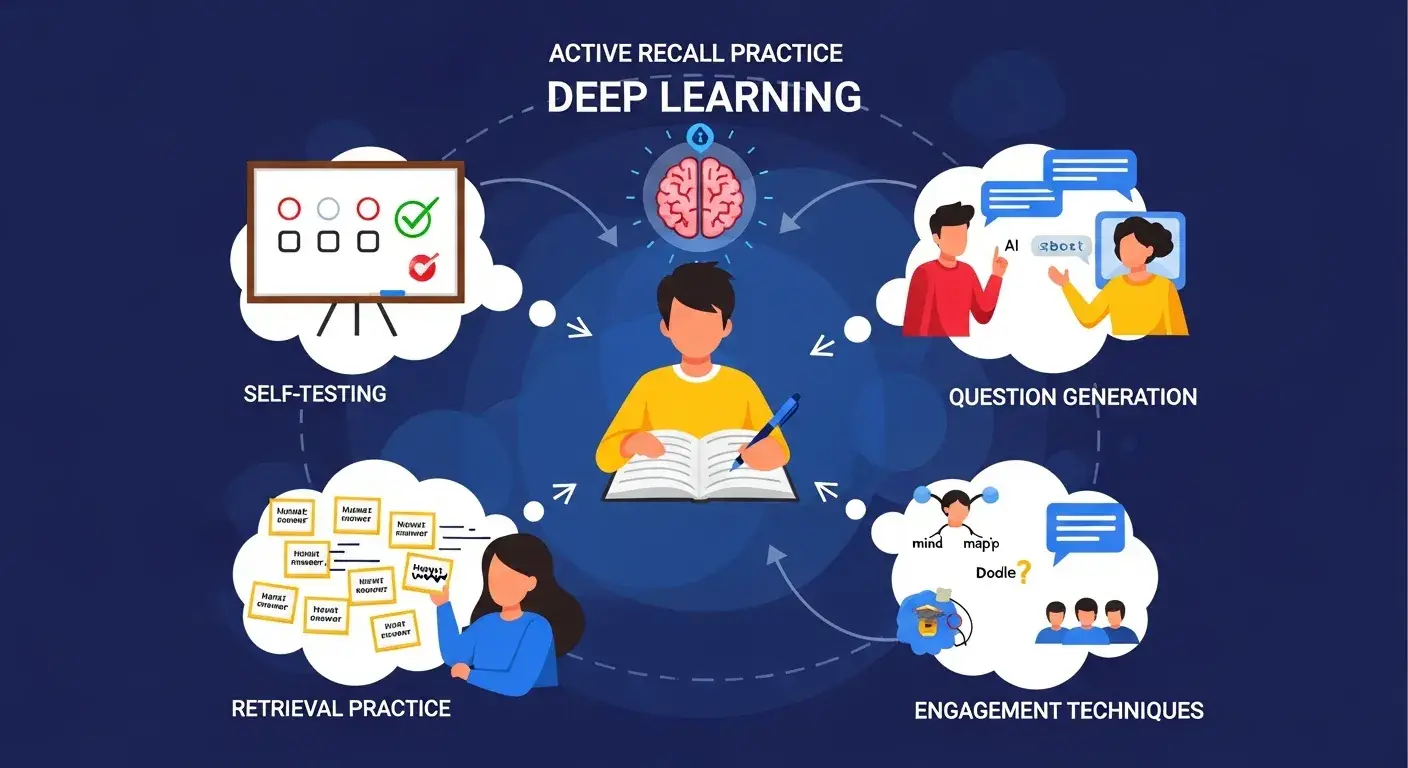
While spaced repetition is a powerful technique on its own, its effectiveness is amplified when combined with active recall. Active recall is the process of retrieving information from memory without looking at the answer. This is precisely what flashcards and SRS systems encourage. Unlike passive re-reading, active recall forces your brain to work harder to access the information, thus strengthening the memory trace more effectively.
Furthermore, many digital SRS platforms incorporate gamification elements, such as points, streaks, and progress tracking. This can significantly boost motivation and engagement, turning the often-tedious process of learning into a more enjoyable and rewarding experience. This gamified approach, especially prevalent in platforms like Duolingo for language learning or Anki for broader subjects, can keep learners consistent and committed, which is crucial for the long-term success of any spaced repetition strategy. A 2023 study in the Journal of Educational Psychology noted that learners using SRS combined with gamified feedback reported higher levels of engagement and sustained motivation compared to those using traditional methods alone.
Benefits of Mastering the Spaced Repetition Technique
The advantages of adopting the spaced repetition technique extend far beyond simply remembering facts. It transforms your entire learning process.
- Enhanced Long-Term Retention: This is the primary benefit. Information learned via spaced repetition is less likely to be forgotten, leading to genuine mastery and understanding.
- Increased Learning Efficiency: By focusing review efforts on material you're about to forget, you eliminate time spent reviewing what you already know well. This makes your study sessions much more productive.
- Reduced Study Time: While it may seem counterintuitive, spaced repetition often requires less total study time than cramming for long-term retention. The optimized review schedule is more efficient.
- Deeper Understanding: The repeated engagement with material, coupled with active recall, encourages deeper processing and understanding of concepts, rather than superficial memorization.
- Improved Confidence: As you successfully recall information over time, your confidence in your knowledge base grows, reducing anxiety around tests or applying learned skills.
- Versatility: This technique is applicable to a vast range of subjects, from languages and history to complex scientific formulas and medical terminology.
Overcoming Challenges with Spaced Repetition
While highly effective, implementing spaced repetition can present a few hurdles. Recognizing these challenges is the first step to overcoming them.
- Initial Setup Time: Creating comprehensive flashcards or setting up an SRS system can take time upfront. However, this investment pays dividends in the long run.
- Maintaining Consistency: The effectiveness of spaced repetition relies on consistent review. Life can get busy, and it's easy to skip a review session.
- Dealing with Difficult Material: Some concepts are inherently harder to grasp. For these, you might need to adjust the intervals or supplement with other learning resources.
- Over-reliance on Memorization: It's important to remember that spaced repetition is a tool for memory. For subjects requiring critical thinking or application, it should be used in conjunction with other learning activities.
To address these, try to integrate SRS reviews into your daily routine, perhaps during commutes or short breaks. For particularly challenging topics, consider creating multiple flashcards that break down the concept into smaller, manageable pieces, or use alternative learning methods like explaining the concept to someone else.
Integrating Spaced Repetition into Different Learning Scenarios
The spaced repetition technique is not a one-size-fits-all solution, but its principles can be adapted to various learning contexts.
Academic Learning
For students, spaced repetition is invaluable for mastering course material. Whether it's memorizing historical dates, scientific terms, or mathematical formulas, using flashcards or SRS apps can significantly boost exam performance. For more complex subjects, breaking down concepts into smaller questions for flashcards can be particularly effective. Many students find that dedicating 15-20 minutes daily to SRS reviews keeps them consistently prepared throughout the semester. For deeper dives into effective study habits, exploring articles on active recall strategies can provide further insights.
Language Acquisition
Learning a new language involves memorizing a vast amount of vocabulary and grammar rules. Spaced repetition is a cornerstone of effective language learning. Apps like Anki and Memrise are designed with language learners in mind, using SRS to help users build extensive vocabulary banks and reinforce grammatical structures over time. The frequent, spaced exposure to new words in context makes them much easier to recall when needed.
Professional Development and Skill Acquisition
In professional settings, the need to acquire and retain new skills or knowledge is constant. Whether it's learning new software, understanding industry regulations, or mastering a complex technical skill, spaced repetition can accelerate the learning curve. For instance, a programmer might use spaced repetition to memorize new syntax or API functions, while a healthcare professional might use it to retain information about new treatments or drug interactions.
Personal Growth and Hobbies
Beyond formal learning, spaced repetition can enhance personal growth. If you're learning a musical instrument, memorizing recipes, or studying a new philosophy, the technique can help you retain that knowledge and skill more effectively. The ability to recall information and apply it consistently leads to greater enjoyment and mastery in any pursuit.
The Future of Spaced Repetition and Personalized Learning
The field of learning science is continually evolving, and spaced repetition is at the forefront of many advancements. Future iterations of SRS are likely to become even more sophisticated, leveraging artificial intelligence to create highly personalized learning paths. These systems could adapt not only to an individual's recall performance but also to their preferred learning styles, cognitive load, and even emotional state, further optimizing the learning experience.
The integration of neurofeedback and biofeedback technologies could also play a role, allowing SRS to fine-tune review intervals based on real-time brain activity, ensuring that material is presented precisely when the learner is most receptive. A report by the Future of Learning Institute in 2025 predicted that AI-driven personalized learning platforms, heavily incorporating spaced repetition principles, will become the dominant model for lifelong learning within the next decade.
Frequently Asked Questions About Spaced Repetition
Q1: How quickly will I see results with spaced repetition? Results vary based on the complexity of the material and your consistency. However, you'll likely notice improved recall within a few days to a week of consistent daily practice, with significant long-term retention building over weeks and months.
Q2: Is spaced repetition only for memorizing facts, or can it be used for understanding concepts? Spaced repetition is highly effective for both. While it excels at memorization (vocabulary, dates), you can also use it for concepts by formulating questions that require explanation or synthesis of information, forcing deeper understanding through active recall.
Q3: What's the difference between spaced repetition and cramming? Cramming involves intense, massed study sessions over a short period, leading to rapid forgetting. Spaced repetition involves distributed review sessions at increasing intervals, optimizing for long-term retention and more efficient learning over time.
Q4: Can I use spaced repetition for learning skills, not just knowledge? Absolutely. For skills, spaced repetition can be applied to the underlying knowledge and procedural steps. For example, a musician might use it for music theory, while a programmer could use it for syntax. Regular practice of the skill itself, informed by spaced repetition of its components, is key.
Conclusion: Embrace Spaced Repetition for Lasting Knowledge
The spaced repetition technique is a scientifically validated method that offers a powerful, efficient, and sustainable path to long-term learning success. By understanding and applying its principles, you can move beyond the frustration of forgotten information and build a robust, enduring knowledge base. Whether you're a student, a professional, or a lifelong learner, integrating spaced repetition into your study habits is one of the most effective strategies you can adopt.
Start small, be consistent, and leverage the many tools available, from simple flashcards to sophisticated SRS software. The effort you invest today in strategic review will yield significant rewards in your ability to recall, understand, and apply what you learn for years to come.
What are your experiences with spaced repetition? Share your favorite tips or tools in the comments below! For more insights on optimizing your learning, consider exploring articles on effective study techniques and memory improvement strategies.